draft
Mutual Aid and Gifts / 助け合いと贈り物¶
A Square focus. Mutual aid, the everyday reciprocity between islanders and the School, is one of the things Group Square works to document: not as an abstraction, but as specific gifts, specific people, specific days. This page collects instances as they happen.
スクエアの取り組み。 助け合い、すなわち島民とスクールのあいだの日々の互恵は、グループ・スクエアが記録しようとしているものの一つである。抽象としてではなく、具体的な贈り物、具体的な人、具体的な日として記録する。このページはそうした出来事を、起きるたびに集めていく。
The kashiwa-mochi welcome / 柏餅のお迎え (2026-06-02)¶
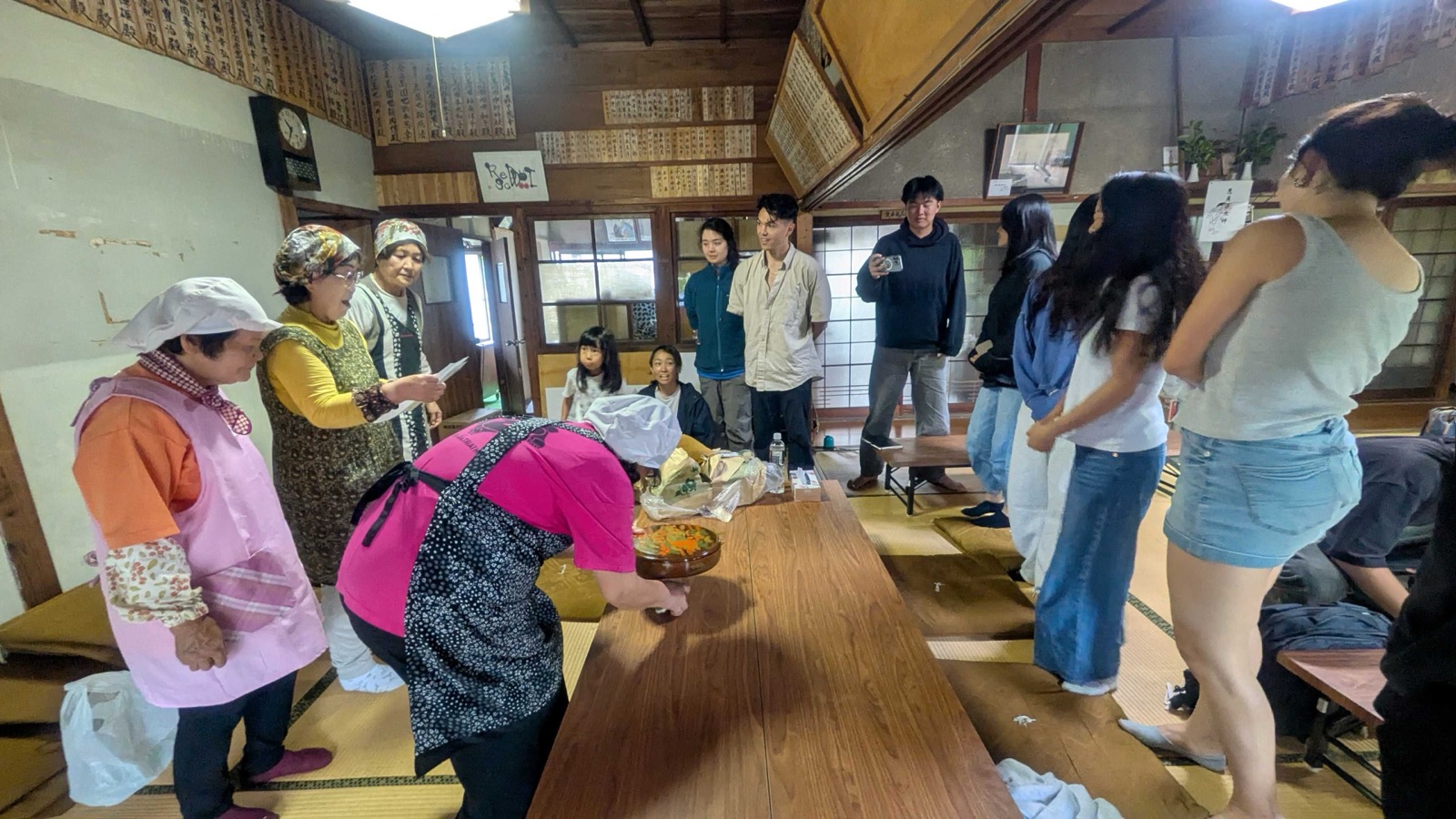
On the morning of June 2, 2026, a group of island grandmothers came to Kakumeisha and gave the School a batch of kashiwa-mochi (柏餅) they had cooked themselves. One of them had prepared a letter in English and read it aloud to the cohort. The gesture is a small, exact example of the mutual-aid culture that surrounds the School on Sagishima: unprompted, hand-made, and folded into the daily rhythm (the letter closes by looking ahead to the next morning's Radio Taiso).
2026年6月2日の朝、島のおばあちゃんたちが格明舎を訪れ、自分たちで作った柏餅をスクールに届けてくれた。そのうちの一人は英語で手紙を用意し、学生たちの前で読み上げた。この振る舞いは、佐木島でスクールを取り巻く助け合いの文化の、小さく的確な一例である。求められたわけでもなく、手作りで、日々の営みのなかに織り込まれている(手紙は翌朝のラジオ体操を楽しみにする言葉で結ばれている)。
The letter / 手紙¶
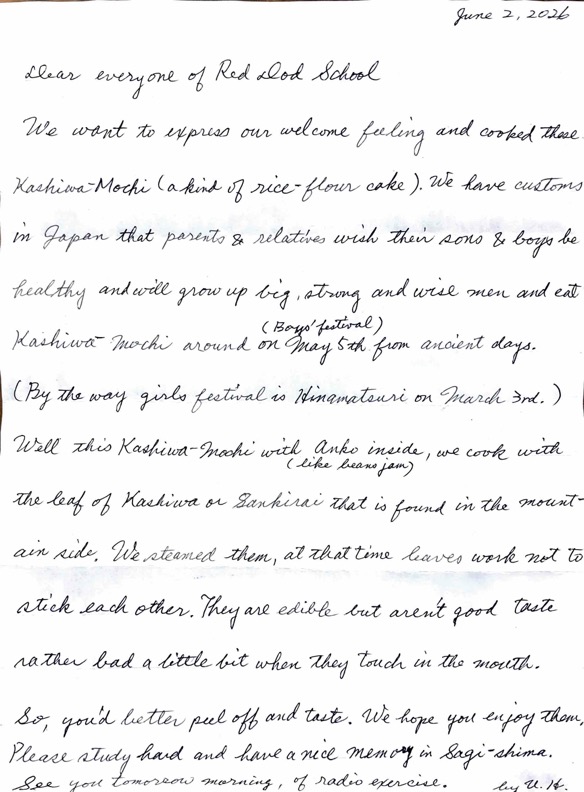
The letter is reproduced verbatim below, then shown as scanned. It is signed only with the initials U.H.
手紙はまず下に原文のまま再録し、続いてスキャン画像で示す。署名はイニシャルのU.H.のみである。
An accompanying envelope (scanned 2026-06-07), addressed simply "To: Red Dot School," carries four senders' names, the grandmothers behind the gift: T. Nakamura, K. Kōno, N. Hiraki, and T. Hiraki (read from the handwriting; the given-name initials and the Nakamura / Hiraki readings are best-effort under ink blotting). How these four relate to the letter's U.H. signature is not established, U.H. may be one of them under a different reading, or the single grandmother who actually penned the letter. The Hiraki and Nakamura names recur in the island's mutual-aid relationships recorded below. (This wiki is internal; keep these resident names out of any outward-facing version, e.g. the Compendium.)
添えられていた封筒(2026年6月7日にスキャン)には「To: Red Dot School」とだけ宛名が記され、贈り物を届けたおばあちゃんたち、すなわち四人の差出人の名が記されている。T. Nakamura(中村)、K. Kōno(河野)、N. Hiraki(平木)、T. Hiraki(平木)である(手書きから読み取ったもので、名のイニシャルおよび中村・平木の読みは、インクのにじみのもとでの最善の推定である)。この四人と手紙の署名U.H.との関係は確定していない。U.H. は別の読みのもとで彼女たちの一人かもしれず、あるいは実際に手紙を書いた一人のおばあちゃんかもしれない。平木と中村の名は、下に記す島の助け合いの関係にも繰り返し現れる。(このウィキは内部向けである。これらの住民の名は、対外的な版(たとえば概要誌)には載せないこと。)
Dear everyone of Red Dot School
We want to express our welcome feeling and cooked these Kashiwa-Mochi (a kind of rice-flour cake). We have customs in Japan that parents & relatives wish their sons & boys be healthy and will grow up big, strong and wise men and eat Kashiwa Mochi around on May 5th (Boys' festival) from ancient days. (By the way girls festival is Hinamatsuri on March 3rd.)
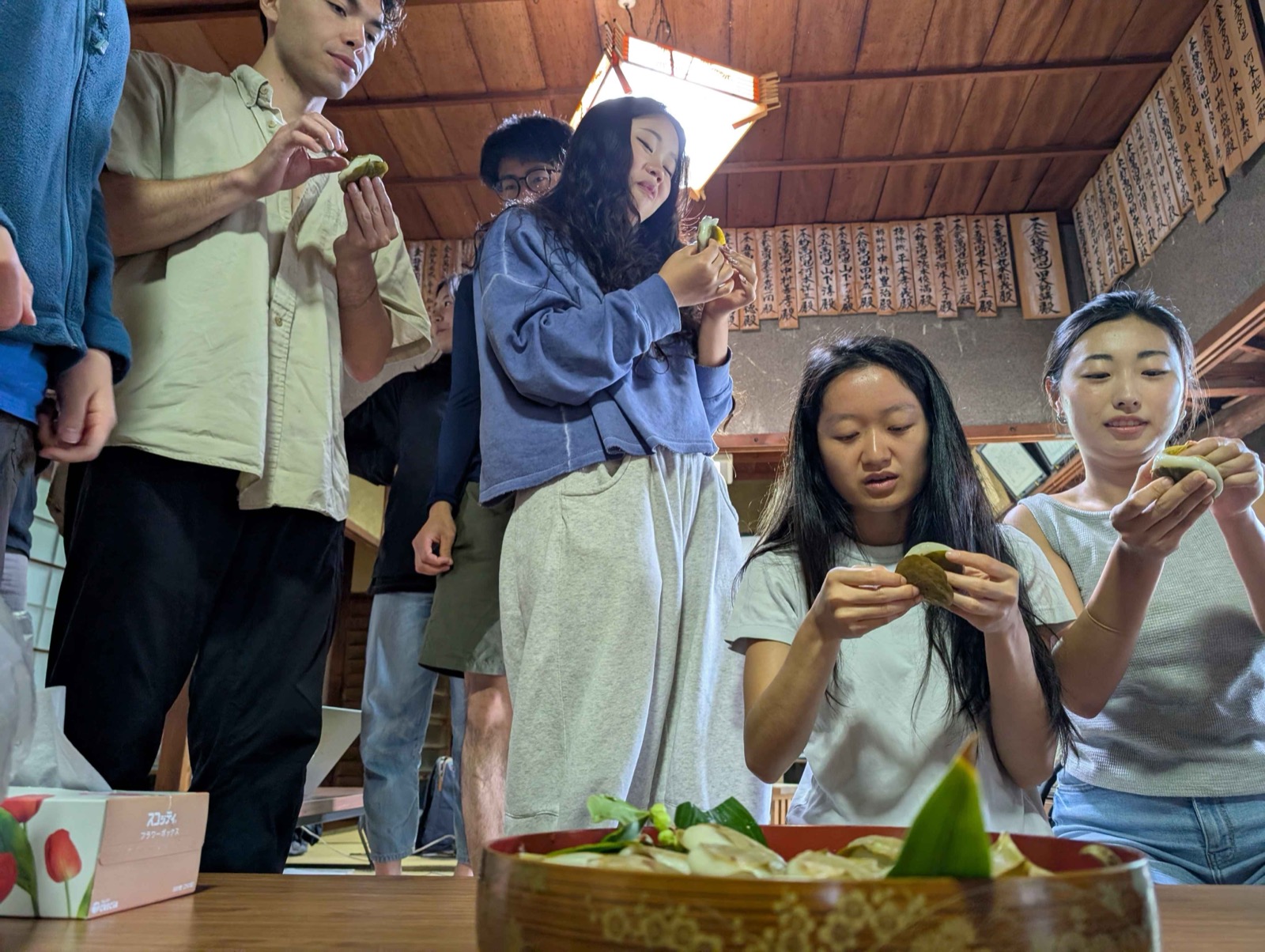
Well this Kashiwa-Mochi with Anko inside (like beans jam), we cook with the leaf of Kashiwa or Sankirai that is found in the mountain side. We steamed them, at that time leaves work not to stick each other. They are edible but aren't good taste rather bad a little bit when they touch in the mouth.
So, you'd better peel off and taste. We hope you enjoy them. Please study hard and have a nice memory in Sagi-shima. See you tomorrow morning, of radio exercise.
by U.H.
レッドドットスクールの皆さんへ
歓迎の気持ちを伝えたくて、この柏餅(米粉のお菓子の一種)を作りました。日本には古くからの習わしがあり、親や親戚が、息子や男の子が健やかに、大きく、強く、賢い人に育つようにと願って、5月5日(男の子のお祭り)の頃に柏餅を食べます。(ちなみに、女の子のお祭りは3月3日の雛祭りです。)
さて、この柏餅は中に餡(豆を煮詰めたジャムのようなもの)が入っていて、山あいで採れる柏やサンキライの葉で包んで作ります。蒸すときに、葉がお互いにくっつかないようにする役目もあります。葉は食べられますが、口に触れるとあまりおいしくなく、むしろ少し良くない味です。
ですので、はがして召し上がるとよいでしょう。気に入っていただけたら嬉しいです。しっかり勉強して、佐木島で良い思い出をつくってください。明日の朝、ラジオ体操でお会いしましょう。
U.H. より
What the gift carries / 贈り物が伝えるもの¶
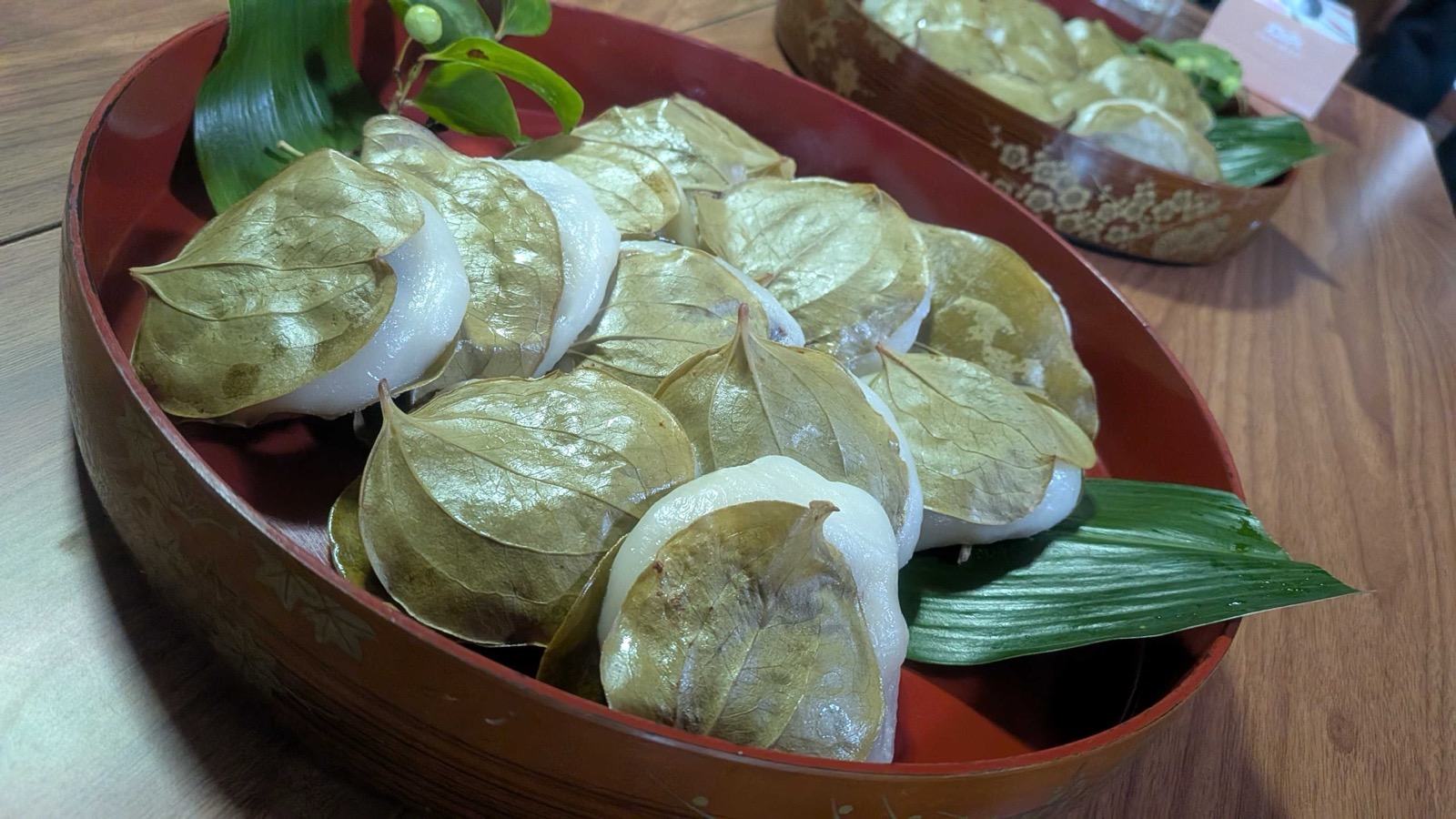
- Kashiwa-mochi (柏餅) is an anko-filled rice-flour cake wrapped in a leaf, eaten around Tango no Sekku (端午の節句, May 5th), the Boys' festival now folded into Children's Day; the leaf wishes health and strong growth for children. The grandmothers' letter pairs it with Hinamatsuri (雛祭り, March 3rd), the girls' festival, for contrast. 柏餅は餡を包んだ米粉の餅を葉でくるんだもので、男の子のお祭りであり今は子どもの日に組み込まれた端午の節句(5月5日)の頃に食べられる。葉には子どもの健康と力強い成長を願う意味がある。おばあちゃんたちの手紙では、対比として女の子のお祭りである雛祭り(3月3日)にも触れている。
- The wrapping leaf is kashiwa (oak) or, as the letter notes for this island, sankirai (サンキライ, Smilax) gathered "in the mountain side", a common western-Japan substitute. The leaf keeps the cakes from sticking during steaming and is peeled off before eating. 包む葉は柏か、あるいは手紙がこの島について記すように、「山あい」で採れるサンキライ(Smilax)で、後者は西日本でよく使われる代用品である。葉は蒸すときに餅同士がくっつくのを防ぎ、食べる前にはがされる。
- The custom belongs to the wider Japanese calendar, but the act, elderly residents cooking for and welcoming a school of newcomers, is the island-specific thing worth recording. この習わし自体は日本全体の年中行事に属するが、記録に値する島ならではのものは、その行為、すなわち年配の住民が新しくやって来た学校のために料理を作り、迎え入れてくれたことである。
Koroku (小六): the older mutual-aid system / 小六:かつての相互扶助の仕組み¶
Resident Mr. Fukuda recalled a former island system called Koroku (小六), in which full-time farmers helped part-time farmers with their work and were thanked not with money but with a shared meal. It is a non-monetary form of community support, the same logic of reciprocity the kashiwa-mochi gift carries, but formalized into a working custom. Group Square reads Koroku as a conceptual spine of island life and a model worth keeping alive as new residents arrive (the Artichoke Project studio work uses it this way).
住民の福田さんは、かつて島にあった「小六」と呼ばれる仕組みを語った。専業農家が兼業農家の作業を手伝い、その返礼を金銭ではなく食事の分かち合いで受け取る、というものである。これは非金銭的な地域の支え合いの形であり、柏餅の贈り物が運ぶのと同じ互恵の論理を、生きた慣習へと形にしたものだ。グループ・スクエアは、小六を島の暮らしの背骨をなす考え方とみなし、新しい住民が訪れるなかで生かし続ける価値のあるモデルとして読んでいる(アーティチョーク・プロジェクトのスタジオの活動がそのように用いている)。
Mutual aid in the fields / 畑の助け合い¶
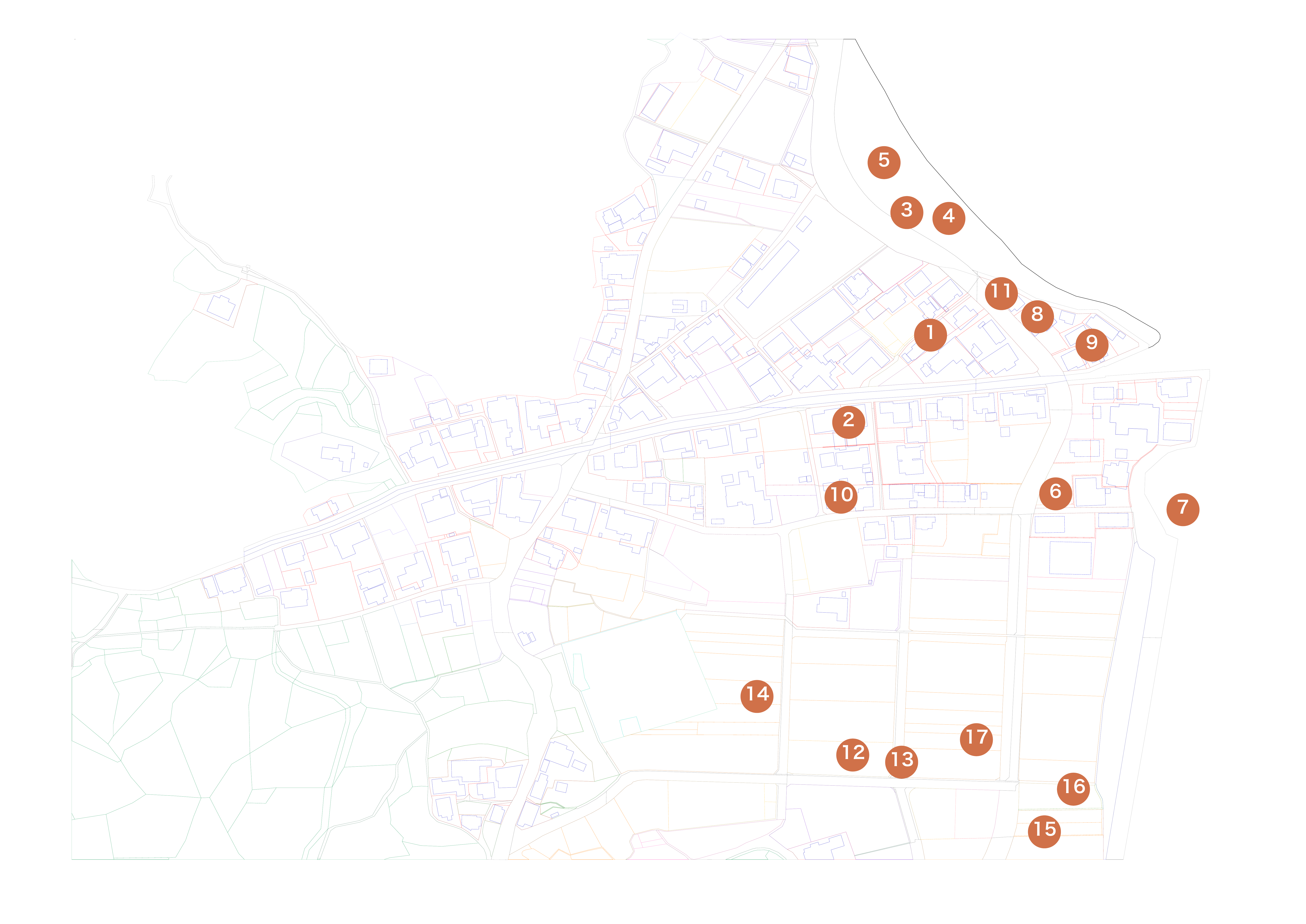
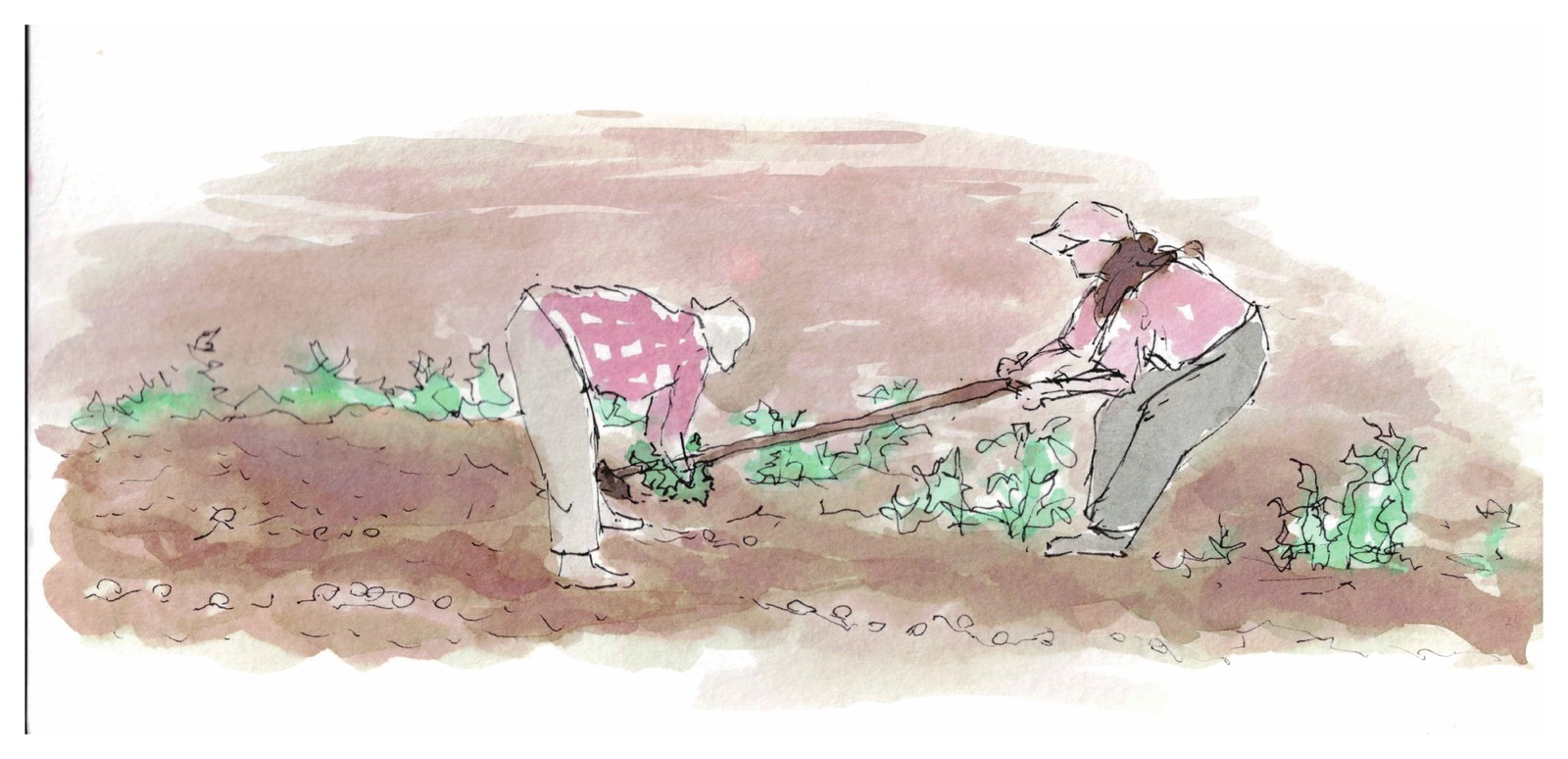
The same reciprocity shows up, undramatically, in how islanders keep each other's land alive. A few instances from the resident interviews:
同じ互恵は、島民が互いの土地を生かし合うやり方のなかに、ことさら劇的でない形で現れる。住民インタビューからのいくつかの例を挙げる。
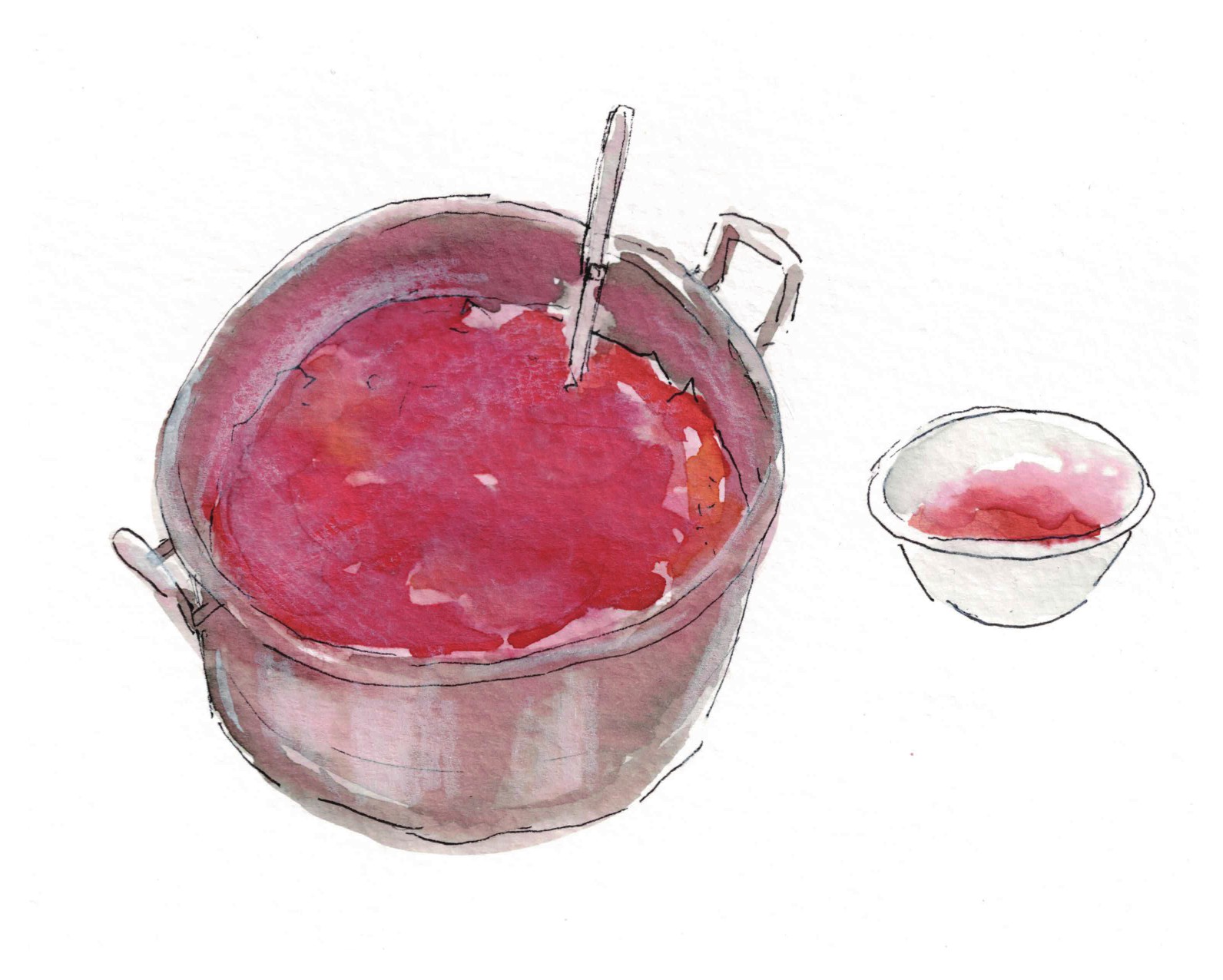
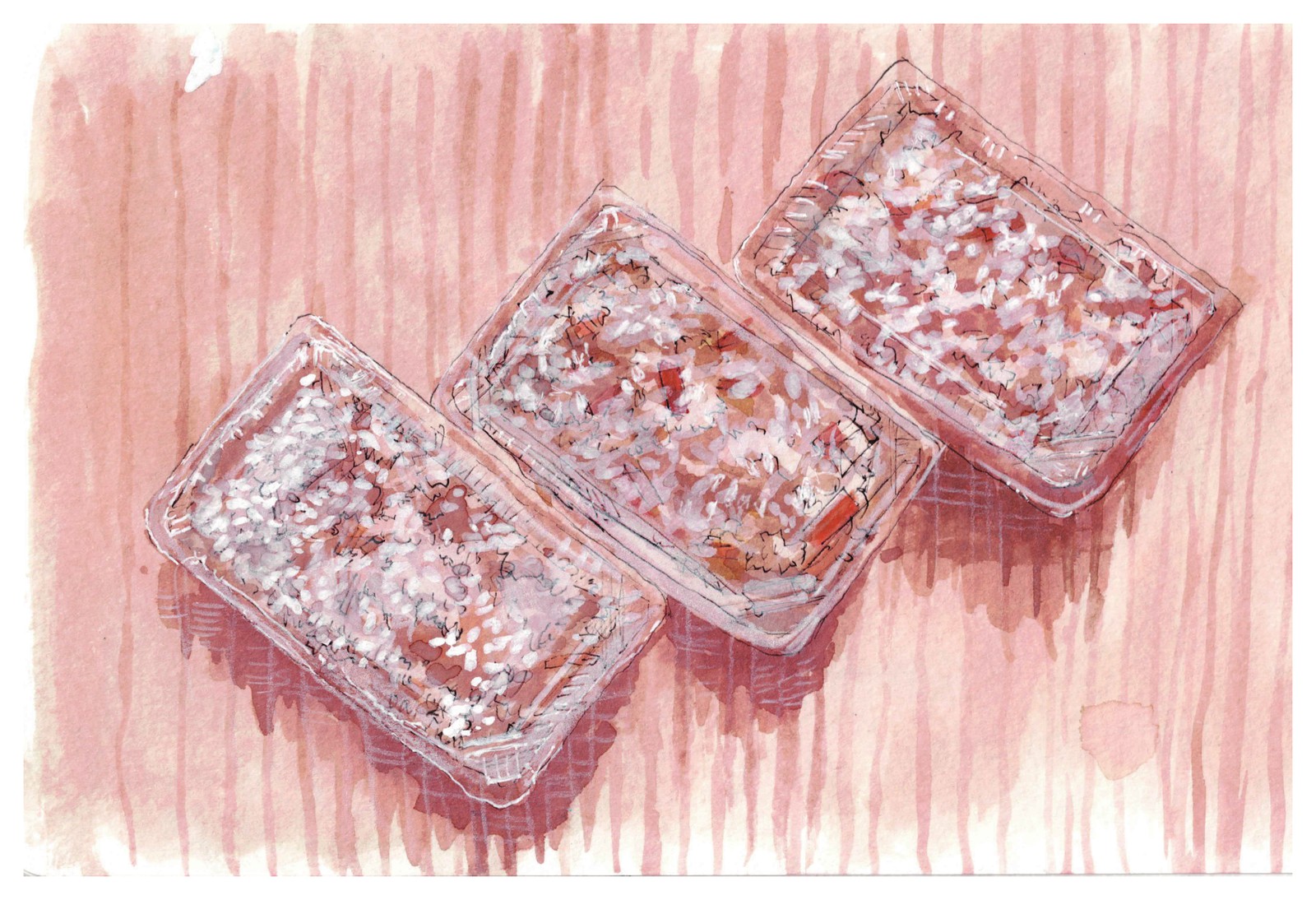
- Mr. Hiraki mows Mr. Yamane's field, and Mr. Yamane (who can no longer farm easily) makes red rice (sekihan) for him on celebratory occasions. Even a little tending keeps wild boar away, so the upkeep is its own kind of neighborly defense. 平木さんが山根さんの畑の草を刈り、もはや農作業の難しい山根さんは、お祝いの折に平木さんへお赤飯を届ける。少しの手入れでもイノシシが寄り付かなくなるため、その手入れ自体が、近隣を守る一種の働きにもなっている。
- Mr. Nakamura gives away unsellable vegetables free of charge to families with young children. 中村さんは、売りものにならない野菜を子育て世代に無償で分けている。
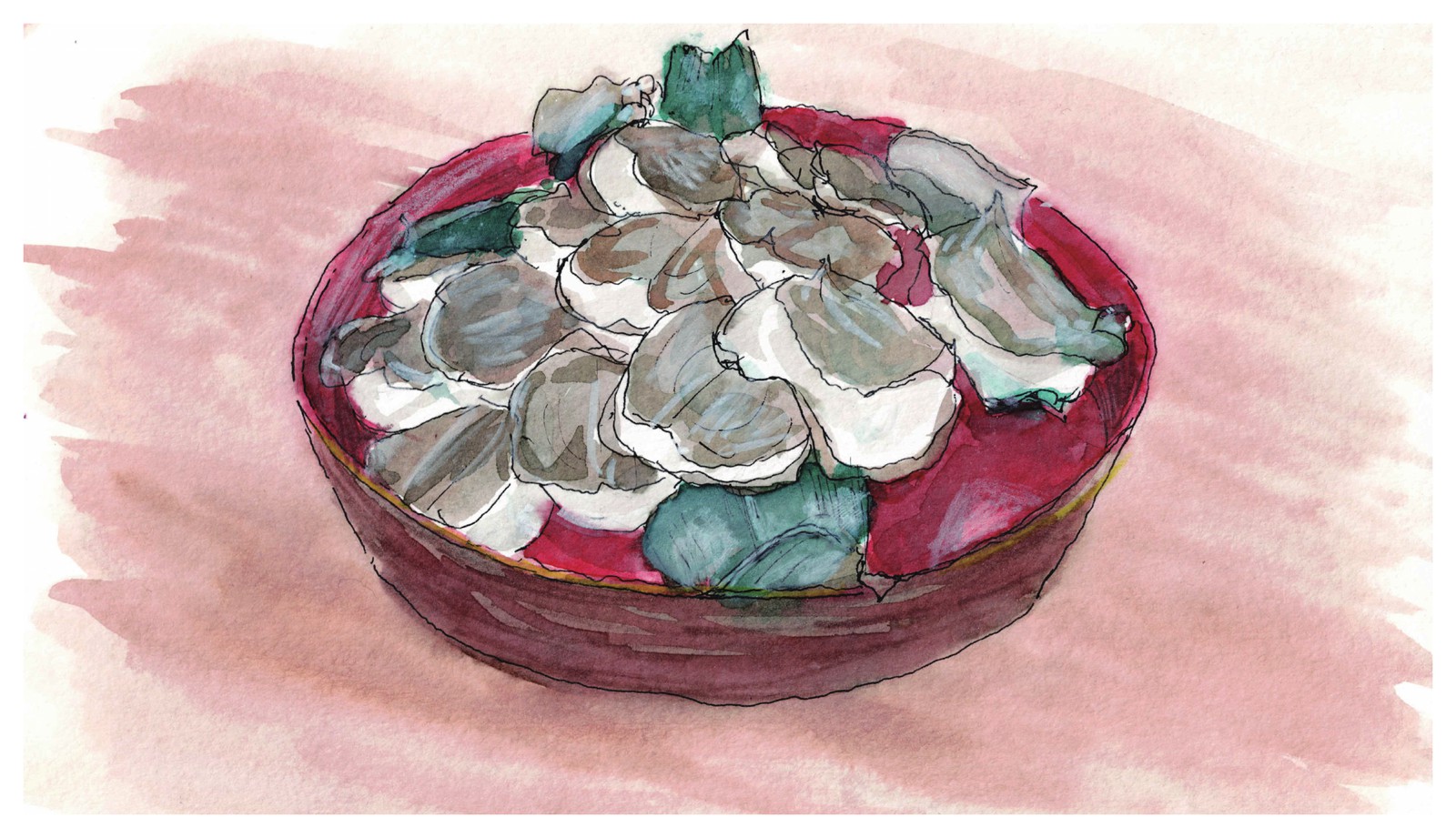
- A school teacher, after a good catch, prepared a large cuttlefish as sashimi and shared it at one of the School's outdoor dinners. 学校の先生は、よい釣果のあと、大きなモンゴウイカを刺身に仕立て、スクールの屋外夕食会で分かち合った。
Group Square illustrated these exchanges in a set of watercolors made for its 2026 deliverables.
グループ・スクエアは、2026年の成果物のために描いた一連の水彩画で、こうしたやり取りを描いている。
Why it matters / なぜ重要か¶
The Foundation's Theory of Change frames its central question as integration versus extraction: whether the School deepens island life or runs parallel to it (the same question the NOT A HOTEL page raises at a very different scale). Mutual aid is where that question is answered in practice, one gift at a time. That the letter ends "see you tomorrow morning, of radio exercise" places the gift inside the very rhythm, Radio Taiso attendance, that the Theory of Change names as its measure of integration. Documenting these exchanges is part of Group Square's work on the island's social fabric.
財団の変化の理論は、その中心的な問いを統合か収奪かとして立てている。すなわち、スクールが島の暮らしを深めるのか、それとも島と並行して走るだけなのか、という問いである(ノットアホテルのページがまったく異なる規模で提起するのと同じ問いだ)。助け合いは、その問いが一つの贈り物ごとに実地で答えられていく場である。手紙が「明日の朝、ラジオ体操で会いましょう」と結ばれていることは、この贈り物を、変化の理論が統合の尺度として挙げるまさにその営み、ラジオ体操への参加のなかに位置づけている。こうしたやり取りを記録することは、島の社会的な織物に関するグループ・スクエアの仕事の一部である。
Related / 関連¶
Reciprocal labor at rice transplanting / 田植えの労働交換 (こうろく)¶
Rice transplanting on Sagishima was usually done by large groups, centered on relatives, who helped one another. This was mutual aid in its most literal agricultural form (さぎしま讃歌 p.38).
佐木島の田植えは、ふつう親族を中心とした大人数の集団で、互いに助け合って行われた。これは農業における最も文字通りの相互扶助の形であった(さぎしま讃歌 p.38)。
The division of work was gendered: men did the ground-firming, marking, and seedling distribution, while women led the actual planting. When the planting was finished, each farm household made a Sanbō-sama (三宝様) offering to the paddy, of sake, washed rice, and octopus or fish, praying for a good harvest, and then laid out a feast to thank the helpers who had worked without pay. This thanking-feast for unpaid helpers was called kōroku (こうろく) (双鷺洲 p.262; さぎしま讃歌 p.38).
作業は男女で分かれていた。男は地ならし、印付け、苗配りを担い、女が実際の田植えを率いた。植え終わると、各農家は田に三宝様へのお供え、すなわち酒、洗い米、蛸や魚を供えて豊作を祈り、無償で働いてくれた手伝い手をもてなす宴を設けた。この無償の手伝い手への返礼の宴はこうろくと呼ばれた(双鷺洲 p.262;さぎしま讃歌 p.38)。
HELD for reconciliation (conflicts with existing page). The existing "Koroku (小六)" section records resident Mr. Fukuda describing Koroku as a system in which full-time farmers helped part-time farmers and were thanked with a shared meal, written 小六. The book sources here give a different word, こうろく (kōroku), written in hiragana, and a narrower meaning: specifically the thank-you feast a farm household holds for its unpaid transplanting helpers (さぎしま讃歌 p.38; 双鷺洲 p.262). Whether these are (a) the same word with the same root logic of non-monetary reciprocity recorded two ways, (b) two related-but-distinct customs, or (c) a coincidence of similar-sounding terms is unresolved. The reading of こうろく and the kanji 小六 both want a native/historian check. Do not collapse the two into one claim until reconciled.
照合のため保留(既存ページと矛盾の可能性)。 既存の「小六(Koroku)」の節では、住民の福田さんが、専業農家が兼業農家を手伝い食事の分かち合いで返礼を受ける仕組みを「小六」と表記して語っている。本資料の語は、ひらがなのこうろくで、より狭い意味、すなわち農家が無償の田植え手伝い手をもてなす返礼の宴を指す(さぎしま讃歌 p.38;双鷺洲 p.262)。両者が同一語か、関連する別の慣習か、音の偶然かは未確定である。こうろくの読みと小六の漢字はいずれも母語話者・歴史家の確認を要する。照合が済むまで一つの主張にまとめないこと。
The village granary and the shasō relief system / 郷倉と社倉法¶
The oldest documented institution of mutual aid on Sagishima is the village granary (郷倉, gōgura, also read kōgura), a communal grain store held against famine. As of 2015, at Mukōda Hachiman Shrine (向田八幡神社) there still stood a structure called Gōgura (ゴウグラ / 郷倉), then used to store the danjiri (檀尻) festival floats but originally an Edo-period emergency grain storehouse (双鷺洲 p.91-92, §12 社倉=郷倉).
佐木島で記録に残る最も古い相互扶助の制度は、飢饉に備えて穀物を蓄える共同の蔵、郷倉である。2015年時点で、向田八幡神社にはゴウグラ(郷倉)と呼ばれる建物が立っており、当時は檀尻(祭りの山車)の収納に使われていたが、もとは江戸期の非常用穀物倉であった(双鷺洲 p.91-92、第12節 社倉=郷倉)。
A grain storehouse (蔵) at Mukōda Hachiman Shrine is attested as early as Genroku 15 (1702) (双鷺洲 p.91), and a granary ("御年蔵") at the shrine appears in a household and cattle census register (家人牛御改帳, kenin-ushi o-aratamechō, reading TENTATIVE) in Kyōhō 5 (1720) (双鷺洲 p.91; printed as 家保5年, corrected here to Kyōhō 5 = 1720, era reading needs review). A grain-relief storehouse (御蔵, o-kura) existed at Mukōda even before the domain formalized the system (双鷺洲 p.92).
向田八幡神社の蔵は早くも元禄15年(1702)に記録があり(双鷺洲 p.91)、同社の「御年蔵」は享保5年(1720)の家人牛御改帳に見える(双鷺洲 p.91。原書はこの年を「家保5年」とするが、ここでは享保5年=1720と訂正した。年号の読みは確認を要する)。藩が制度化する以前から、向田には穀物救済のための御蔵が存在した(双鷺洲 p.92)。
The Hiroshima domain established the shasō-hō (社倉法), a mutual-relief system of grain storehouses (社倉) for famine years, in Meiwa 1 (1764); officials were posted to the Mukōda granary, which the island called gōgura (双鷺洲 p.91; printed as 明和1年(1770), but Meiwa 1 = 1764, so the era-year and Western year disagree; flagged). By the Tenmei era (1781-1789) there was no town or village in the district without such a granary (双鷺洲 p.92).
広島藩は、飢饉の年のための社倉による相互救済制度、社倉法を明和元年(1764)に定めた。向田の郷倉には役人が置かれた(双鷺洲 p.91。原書は「明和1年(1770)」と記すが、明和元年=1764で、年号と西暦が一致しない。要確認)。天明年間(1781-1789)までには、郡内に郷倉を持たない町村はなかった(双鷺洲 p.92)。
For Mukōda-Noura Village (向田野浦村), a Tenmei-era record gives the granary's holdings in Tenmei 6 (1785) as 28 koku 7 to 7 shō of grain (石数弐拾八石七斗七升) and 2 kan 877 mon of chōsen cash (丁銭弐貫八百七拾七文), contributed at a rate of 100 mon per koku (双鷺洲 p.92-93). The same document explains kuroku-sen (九六銭), the convention of counting 96 coins as 100 mon, as against counting a literal 100 (双鷺洲 p.93). Relief barley stored against famine was called kyūbaku (救麦), and when enough had been saved to cover need, the system was said to have reached shasō-hō jōju (社倉法成就, completion of the shasō system) (双鷺洲 p.93).
向田野浦村については、天明期の記録が、天明6年(1785)の郷倉の蓄えを穀物弐拾八石七斗七升、丁銭弐貫八百七拾七文とし、拠出率は一石あたり百文とする(双鷺洲 p.92-93)。同じ文書は、銭を実数百枚ではなく九十六枚で百文と数える慣習、九六銭を説明している(双鷺洲 p.93)。飢饉に備えて蓄えた救済用の麦は救麦と呼ばれ、必要を賄うだけ蓄えられた状態を社倉法成就と称した(双鷺洲 p.93)。
The granary building, originally thatched (茅葺), was later rebuilt with a tile roof (瓦葺), probably as a fire precaution (双鷺洲 p.92).
郷倉の建物は当初茅葺であったが、後に瓦葺に建て替えられた。おそらく火災予防のためである(双鷺洲 p.92)。
Donated labor and named relief-givers / 寄進の労役と救済の人々¶
The granary itself was built by mutual aid. A Tenmei 6 (1785) document records that when the shasō granary was raised, villagers each donated tea-nets, bamboo, timber and the like, and gave their labor without charge. The document names the Mukōda-Noura Village headman (庄屋, shōya) of the era, of the Niiya-Nishihara household (新屋西原庄蔵, Niiya Nishihara Shōzō, reading TENTATIVE) (双鷺洲 p.92).
郷倉そのものも相互扶助によって建てられた。天明6年(1785)の文書は、社倉を建てる際、村人がそれぞれ茶網、竹、材木などを寄進し、無償で労役を供したと記す。文書はその時代の向田野浦村庄屋、新屋西原庄蔵(読みは暫定)の名を挙げている(双鷺洲 p.92)。
Names and readings in this paragraph derive from a classical-Japanese document and want a native/historian check; "新屋西原庄蔵" may be a household-and-given-name compound rather than a single personal name. この段落の名と読みは古文書に由来し、母語話者・歴史家の確認を要する。「新屋西原庄蔵」は単一の人名ではなく、屋号と名の複合である可能性がある。
A Bunkyū 2 (1862) document concerning the divisional headman (割庄屋, wari-shōya) records relief given in a poor-harvest year, the almsgiving of cooked rice and gruel (施行飯汁, segyō meshi-jiru) to those in distress, and praises the granary's contribution (双鷺洲 p.92-93).
割庄屋に関する文久2年(1862)の文書は、不作の年に困窮者へ施された炊いた飯や汁の施し(施行飯汁)を記録し、郷倉の貢献を讃えている(双鷺洲 p.92-93)。
After the Meiji 2 (1869) crop failure (明治2年の凶作), the Hiroshima domain government in Meiji 4 (1871) granted 35 monme of silver (銀三五匁) to Nishihara Shōzō (西原庄蔵, reading TENTATIVE) for his relief efforts, and in the same year awarded 75 monme of silver (銀七五匁) commending Yamashita Sukezaemon (山下助左衛門, reading TENTATIVE) for the stored rice he had supplied during that famine (双鷺洲 p.92-93).
明治2年(1869)の凶作の後、広島藩庁は明治4年(1871)、その救済の働きに対し西原庄蔵(読みは暫定)へ銀三五匁を下賜し、同年、その飢饉の際に蓄え米を供出した山下助左衛門(読みは暫定)を銀七五匁で表彰した(双鷺洲 p.92-93)。
The "明治2 (1869) famine / 明治4 (1871) award" dates are internally consistent (Meiji 2 = 1869, Meiji 4 = 1871). Personal-name readings and silver figures are from a classical-JA source; flagged for historian review. 「明治2年(1869)の飢饉/明治4年(1871)の褒賞」の年は整合している(明治2=1869、明治4=1871)。人名の読みと銀の数値は古文書由来。歴史家の確認のため保留。
Mutual aid as public works / 公共事業としての助け合い¶
The reciprocity recorded in the fields also built the island's shared infrastructure through donation and volunteer service.
田で記録された互恵は、寄付と奉仕によって島の共有の基盤をも築いた。
In Shōwa 25 (1950), Mukōda ward (向田区) improved the coast behind the Waryōishi Jizō (和霊石地蔵, reading TENTATIVE), and Sagi ward (佐木区) improved the Umakoshi village road (馬越里道, Umakoshi ridō), both through donation and volunteer service (さぎしま讃歌 p.98).
昭和25年(1950)、向田区は和霊石地蔵(読みは暫定)の裏手の海岸を、佐木区は馬越里道を、いずれも寄付と奉仕作業によって改修した(さぎしま讃歌 p.98)。
A memoir of Shōwa 21-22 (1946-1947) records that the schoolyard was greatly expanded by the volunteer labor of the whole district (区民総出の奉仕作業): beach earth and sand were pushed up by trolley cart (トロッコ) and the land was graded (双鷺洲 p.199).
昭和21-22年(1946-1947)の回想は、校庭が区民総出の奉仕作業によって大きく拡張されたと記す。浜の土砂をトロッコで運び上げ、地ならしをしたのである(双鷺洲 p.199)。
School, family, and community as one / 学校・家庭・地域が一つに¶
Mutual aid extended to the care of children so that parents could work. A village day-care was run with school teachers, the principal, and the teachers' wives at its core, with the village head (村長) and ward heads (区長) and the wider community taking part, so that parents could farm with peace of mind. It is described as school, family, and community acting together (さぎしま讃歌 p.56).
助け合いは、親が働けるよう子の世話にも及んだ。村の託児は、学校の教員、校長、教員の妻たちを中心に、村長や区長、そして地域全体が加わって運営され、親は安心して農作業ができた。それは学校・家庭・地域が一体となって動いた営みと記されている(さぎしま讃歌 p.56)。
The school boat (通学船) that ferried children was likewise a shared responsibility. The boatman (船頭) was assigned by a rotating one-year-turn system agreed among local adults; it was not always a man, and when no man was available a woman rowed out to fetch the children (双鷺洲 p.124).
子どもを渡した通学船もまた、共同の責任であった。船頭は地域の大人たちの取り決めにより一年交代の輪番で割り当てられ、必ずしも男とは限らず、男手がないときは女が子どもを迎えに漕ぎ出した(双鷺洲 p.124)。
The children's signals to summon the fetch-boat evolved over time, from shouting loudly, to blowing a bugle (ラッパ) or conch (ほら貝), to lighting bonfires. On the Sagi Shirikawa coast (尻川海岸) a white flag run up (白旗がスルスルと揚がる) signaled that school had finished, though the busy boatman sometimes did not notice (双鷺洲 p.124).
迎えの舟を呼ぶ子どもたちの合図は時代とともに変わり、大声で叫ぶことから、ラッパやほら貝を吹くこと、さらには焚き火へと移った。佐木の尻川海岸では白旗がスルスルと揚がることで放課を知らせたが、忙しい船頭が気づかないこともあった(双鷺洲 p.124)。
The youth associations / 青年団・青年会 (§37)¶
Sagishima's youth associations were a long-running organ of communal self-help and self-cultivation (修養), and their structure changed repeatedly over time.
佐木島の青年団は、共同の自助と修養を担う長く続いた組織であり、その仕組みは時代とともに繰り返し変わった。
Before about Meiji 30 (c.1897), the Sagiura Village (鷺浦村) youth groups were separate in each of the three districts, all called wakarenjū (若連中) (双鷺洲 p.230, §37). After about that year they were renamed by district: Mukōda → Shūsaisha (修斎社), Sunoue → Seinenkai (盛年会), and Sagi → Seinenkai (青年会) (readings of 修斎社 and 盛年会 TENTATIVE) (双鷺洲 p.230).
明治30年(およそ1897)頃まで、鷺浦村の青年集団は三地区それぞれで別個に、いずれも若連中と呼ばれていた(双鷺洲 p.230、第37節)。その頃以降、地区ごとに改称された。向田→修斎社、須ノ上→盛年会、佐木→青年会である(修斎社・盛年会の読みは暫定)(双鷺洲 p.230)。
In February of Meiji 41 (1908) the districts federated into the Sagiura Village Youth Association (鷺浦村青年会), with a branch (支会) in each district. In August of Meiji 43 (1910) the branches were abolished and renamed business districts (事業区): Sagi as the First, Mukōda as the Second, Sunoue as the Third (双鷺洲 p.230). In the Taishō era the body became the Sagiura Village Youth Corps (鷺浦村青年団), its main purpose self-cultivation (修養), and it was (re)formed again in Shōwa 25 (1950) (双鷺洲 p.230).
明治41年(1908)2月、三地区は連合して鷺浦村青年会となり、各地区に支会を置いた。明治43年(1910)8月、支会は廃され事業区と改称された。佐木が第一、向田が第二、須ノ上が第三である(双鷺洲 p.230)。大正期には鷺浦村青年団となり、その主目的は修養であった。昭和25年(1950)に再び結成された(双鷺洲 p.230)。
A branch of the Shūyōdan (修養団) self-cultivation society was established at Mukōda after the first such training session (第一回修養団講習会) was held (双鷺洲 p.232).
向田では第一回修養団講習会が開かれた後、修養団の支部が設けられた(双鷺洲 p.232)。
What the youth associations did / 青年会の事業 (Meiji 44 / 明治44年度)¶
By the Meiji 44 (1911) fiscal year, the program of the youth associations had organized mutual aid as a standing institution (双鷺洲 p.232-233):
明治44年度(1911)には、青年会の事業は相互扶助を常設の制度として組織していた(双鷺洲 p.232-233)。
- Education and training. Enrolling members of all three districts in supplementary schools; physical training (a sumo ring, 土俵, built in each district, sumo encouraged, school gymnastics equipment opened to members); and a once-yearly association journal, Sōsagi (双鷺), volume 1 (双鷺洲 p.232). 教育と訓練。 三地区の会員を補習学校に入れ、体育を奨励し(各地区に土俵を築き、相撲を勧め、学校の体操器具を会員に開放した)、年に一度、会誌双鷺 第一巻を発行した(双鷺洲 p.232)。
- A circulating book collection (巡回文庫), purchasing books for the members of each district to read in rotation (双鷺洲 p.232-233). 巡回文庫。 各地区の会員が順に読むための本を購入した(双鷺洲 p.232-233)。
- Care for soldiers: sending consolation letters (慰問状) to enlisted soldiers once a year in winter, and seeing off and welcoming soldiers entering and leaving the barracks (入退営兵士の送迎) (双鷺洲 p.232-233). 兵士への配慮。 冬に年一度、入営兵へ慰問状を送り、入退営兵士の送迎を行った(双鷺洲 p.232-233)。
- First Business District (Sagi) results, Meiji 44: a monthly meeting for moral and public-order improvement (風紀改善); a joint savings scheme (共同貯金) of 3 sen per person per month; and additions to a basic-property fund (基本財産). (Reported totals, such as 18 yen 44 sen, cumulative 193 yen 91 sen, and 222 yen 34 sen, are garbled and want verification against the original.) (双鷺洲 p.232-233). 第一事業区(佐木)の明治44年の実績。 風紀改善のための月例会、一人月3銭の共同貯金、基本財産への積み増し。(合計額、たとえば18円44銭、累計193円91銭、222円34銭などは乱れており、原本との照合を要する。)(双鷺洲 p.232-233)。
The associations also acted as a rapid mutual-aid response in emergencies. When a district household suffered a house fire on August 20, members helped fight the fire and collected and donated 20 yen 26 sen; the business district added 1 yen 50 sen, and chief clerk Yoshimoto Ryōnosuke (吉本良之助, reading TENTATIVE) visited on the members' behalf to offer condolences (双鷺洲 p.234). When a household at the place called Yubune (湯船, reading TENTATIVE) suffered a fire on January 11, members helped fight it and gave 2 yen as a sympathy gift (双鷺洲 p.235). Letters of condolence were also sent to a secretary (kanji) who was ill and away receiving treatment, on November 7 and again on November 1, Meiji 44 (1911) (双鷺洲 p.234, p.236).
青年会は緊急時の即応的な相互扶助としても働いた。8月20日に区内の一戸が火事に遭うと、会員は消火を助け、20円26銭を集めて寄付し、事業区も1円50銭を加え、主事の吉本良之助(読みは暫定)が会員を代表して見舞った(双鷺洲 p.234)。湯船(読みは暫定)という地名の一戸が1月11日に火事に遭うと、会員は消火を助け、見舞いとして2円を贈った(双鷺洲 p.235)。療養のため離れていた病気の幹事へは、11月7日および明治44年(1911)11月1日に見舞状が送られた(双鷺洲 p.234、p.236)。
Rebuilding the cooperative without pay / 無報酬での農協再建¶
The same ethic carried into the postwar institutions. After the war, when the Mukōda Agricultural Cooperative (向田農協) was near bankruptcy from poor performance, Nishihara Michio (西原道男) was asked to serve as cooperative head (組合長) and rebuilt it without compensation; a photograph shows him at the cooperative around Shōwa 37 (c.1962) (さぎしま讃歌 p.194).
同じ倫理は戦後の制度にも受け継がれた。戦後、向田農協が不振から倒産寸前に陥ったとき、西原道男が組合長を依頼され、無報酬でこれを再建した。昭和37年(およそ1962)頃の農協での彼の写真が残る(さぎしま讃歌 p.194)。
Reading of 西原道男 as "Nishihara Michio" follows the standard reading but wants confirmation; note the surname 西原 (Nishihara) recurs among the granary relief-givers (above), which may indicate a long-standing family role in island mutual aid (HELD as an observation, not a sourced claim). 西原道男の「Nishihara Michio」は標準的な読みに従うが確認を要する。姓の西原は上記の郷倉の救済者にも繰り返し現れ、島の相互扶助における一族の長きにわたる役割を示すかもしれない(観察として保留。出典のある主張ではない)。
In bad years / 凶年には¶
In bad years farmers struggled to live. The village would pool and distribute relief rice (救助米, kyūjomai), and households with many children, unable to raise them all, often sent children into service (奉公, hōkō) (双鷺洲 p.252, quoting 三原市史 / Mihara City History).
凶年には農民は生きるのに苦しんだ。村は救助米を出し合って分配し、子だくさんで養いきれない家は、しばしば子を奉公に出した(双鷺洲 p.252、三原市史を引用)。
Sources / 出典¶
- Primary: the handwritten welcome letter (signed U.H., dated 2026-06-02), transcribed verbatim above and shown as scanned; photographs taken at Kakumeisha on 2026-06-02 (the welcome, the mochi close-up, the tasting). Faces are shown: the wiki is internal, and the child pictured is an instructor's. Originals (letter scan + full-resolution photos + the envelope scan,
kashiwa_mochi_envelope.pdf, naming the four senders) archived in the primary-source library at_sources/field_documents/2026-06-02_kashiwa_mochi/. 一次資料: 手書きの歓迎の手紙(署名U.H.、2026年6月2日付)。上に原文のまま再録し、スキャン画像で示した。2026年6月2日に格明舎で撮影した写真(歓迎の様子、餅の接写、試食)。顔が写っているが、このウィキは内部向けであり、写っている子どもは講師の子である。原本(手紙のスキャン、高解像度の写真、および四人の差出人の名が記された封筒のスキャンkashiwa_mochi_envelope.pdf)は一次資料ライブラリの_sources/field_documents/2026-06-02_kashiwa_mochi/に保管されている。 -
Primary (Koroku and field mutual aid): Square field interviews, Sagishima, 2026-05-30 (Mr. Fukuda on Koroku; Mr. Hiraki and Mr. Yamane; Mr. Nakamura; the school teacher), and the Square Sunoue mutual-aid map, 2026 (the seventeen mapped sites; points not individually keyed). Full accounts on Resident Voices. 一次資料(小六と畑の助け合い): 佐木島でのスクエアによるフィールドインタビュー、2026年5月30日(小六について福田さん、平木さんと山根さん、中村さん、学校の先生)、およびSquareによる須ノ上の助け合いの現地図、2026年(十七の地点。各点は個別に対応づけていない)。詳しい語りは住民の声にある。
-
さぎしま讃歌 (Sagishima Sanka), pp. 38, 56, 98, 194: reciprocal transplanting labor and kōroku; the village day-care; 1950 Mukōda/Sagi public-works volunteer service; Nishihara Michio rebuilding the Mukōda Agricultural Cooperative without pay. さぎしま讃歌 pp. 38, 56, 98, 194:田植えの労働交換とこうろく、村の託児、昭和25年の向田・佐木の奉仕作業、西原道男による向田農協の無報酬再建。
- 双鷺洲 (Sōroshū), pp. 91-93, 124, 199, 230, 232-236, 252, 262: the 郷倉 / 社倉法 granary system and its named relief-givers; the rotating school-boat boatman and fetch signals; the Shōwa 21-22 schoolyard volunteer expansion; the youth associations (§37) and their Meiji-44 program; relief rice (救助米) and service (奉公), the latter quoting 三原市史 (Mihara City History). 双鷺洲 pp. 91-93, 124, 199, 230, 232-236, 252, 262:郷倉・社倉法の制度とその救済者たち、輪番の通学船船頭と迎えの合図、昭和21-22年の校庭奉仕拡張、青年団(第37節)と明治44年度の事業、救助米と奉公(後者は三原市史を引用)。
- Several 双鷺洲 entries derive from classical-Japanese documents with uncertain name-readings (新屋西原庄蔵, 西原庄蔵, 山下助左衛門, 吉本良之助, 和霊石地蔵, 湯船), at least one disputed era-year (明和1年 printed as 1770 but = 1764; 家保5年 corrected to 享保5年 = 1720), and OCR-garbled monetary figures. All such points are flagged in place and want native-speaker and local-historian review before any outward-facing use. 双鷺洲の複数の項目は、読みの不確かな人名(新屋西原庄蔵、西原庄蔵、山下助左衛門、吉本良之助、和霊石地蔵、湯船)を含む古文書に由来し、少なくとも一つの年号の不一致(明和1年が1770と印字されるが実際は1764、家保5年を享保5年=1720に訂正)、およびOCRの乱れた金額を含む。これらの点はすべて該当箇所で明示しており、対外的な使用の前に母語話者および郷土史家の確認を要する。