draft
Salt Fields / 塩田
All facts below are drawn from the primary local history さぎしま讃歌. Japanese names, units, and dates are authoritative; the book's own English/romaji is not used. Readings marked (TENTATIVE) and any classical-Japanese-derived figures or OCR-damaged numbers need native-reader and local-historian review before formal use.
以下の事実はすべて、一次的な郷土史である『さぎしま讃歌』による。人名・地名・単位・年代は日本語を典拠とし、書籍自身の英語表記やローマ字は用いない。(TENTATIVE) と記した読み、および古文書由来の数値やOCRで損なわれた数字は、正式な使用の前に母語話者および郷土史家の確認を要する。
Overview / 概要
Salt was one of Sagishima's defining shore industries. Salt fields (塩田) operated in several districts: the Mukōda salt fields (向田の塩田), the Sagi salt fields (佐木の塩田), and the Sunoue salt fields (須ノ上の塩田). Two production types were used: the irihama type (入浜式塩田) and the ryūka type / branch-joist liquid-flow type (流下式塩田(枝条架式)) (さぎしま讃歌 p.2-7).
塩は佐木島を象徴する浜辺の産業の一つであった。塩田は複数の地区にあった。向田の塩田、佐木の塩田、須ノ上の塩田である。製塩方式は二種類が用いられた。入浜式塩田と、流下式塩田(枝条架式)である(『さぎしま讃歌』p.2-7)。
How salt was made: the three methods / 製塩の三つの方式
The island's salt-making evolved through three successive methods, each less laborious than the last.
島の製塩は、三つの方式を順に経て発達し、後のものほど労力が小さくなった。
- Age-hama (揚げ浜) method, until the medieval period. Until medieval times, salt was produced all along the seashore by the age-hama evaporation method (揚げ浜式製塩法) (さぎしま讃歌 p.118). 揚げ浜式、中世まで。 中世まで、塩は海岸沿いの各所で揚げ浜式製塩法によって作られた(『さぎしま讃歌』p.118)。
- Irihama (入浜) method, from the Edo period. In the Edo period the irihama method (入浜式製塩法) was introduced, enabling large-scale salt production (さぎしま讃歌 p.118). 入浜式、江戸期から。 江戸期に入浜式製塩法が導入され、大規模な製塩が可能となった(『さぎしま讃歌』p.118)。
- Ryūka-shiki (流下式 / branch-rack, 枝条架式) method, from around 1953 (Shōwa 28). Around 1953 salt production was improved to the ryūka-shiki method (流下式製塩法(枝条架式)), and later switched to the lower-cost ion-exchange-membrane method (イオン交換膜法) (さぎしま讃歌 p.118). 流下式(枝条架式)、1953年(昭和28)頃から。 1953年頃、製塩は流下式製塩法(枝条架式)へと改良され、のちにより低コストのイオン交換膜法へと切り替わった(『さぎしま讃歌』p.118)。
The irihama method in practice / 入浜式の実際
The irihama salt field used ground-percolation: seawater was spread on the sandy beach, salt crystallized on the sand surface, and from this a concentrated brine (kansui / かん水) was made (さぎしま讃歌 p.120). The labor was extreme. To make brine equivalent to 1 ton of salt, about 200 tons of sand and seawater were needed, said to be extremely heavy work (さぎしま讃歌 p.120).
入浜式塩田は地下浸透を利用した。砂浜に海水をまき、砂の表面に塩を結晶させ、そこから濃いかん水を作った(『さぎしま讃歌』p.120)。労力は過酷で、塩1トン分のかん水を作るのに約200トンの砂と海水を要し、極めて重労働であったという(『さぎしま讃歌』p.120)。
In the irihama era, the salt workers (hamako / 浜子) were said to walk about 25 km per day per unit area doing beach-hauling (hamabiki / 浜曳き) and other tasks (さぎしま讃歌 p.120). (Review note: the unit printed in the source is the unusual '陌当り'; it is likely '反当り', i.e. per-tan. Flagged for native/historian review.)
入浜の時代、浜子は単位面積あたり一日に約25kmを浜曳きなどの作業で歩いたとされる(『さぎしま讃歌』p.120)。(確認事項:原典に印字された単位は珍しい「陌当り」であり、おそらく「反当り」(一反あたり)と思われる。母語話者・郷土史家の確認を要する。)
The ryūka-shiki (branch-rack) method in practice / 流下式(枝条架式)の実際
The ryūka-shiki method hung bamboo branches and dripped seawater over them to concentrate the brine; it greatly raised output per unit and cut labor. Where the irihama method required 5 workers per unit area, the ryūka method needed only 1 (さぎしま讃歌 p.124).
流下式は竹の枝を吊るし、その上に海水を滴らせてかん水を濃縮した。これにより単位あたりの産出が大きく増え、労力が削減された。入浜式が単位面積あたり5人を要したのに対し、流下式は1人で済んだ(『さぎしま讃歌』p.124)。
(Review note: the brine-yield figures on p.124 are garbled in the source: irihama "100トン" vs ryūka "000トン". The ryūka figure is OCR-damaged / corrupt and is therefore NOT reproduced as a number here. The labor figures 5 to 1 per unit area are clear in the source.)
(確認事項:p.124のかん水産出量の数値は原典で崩れている。入浜「100トン」に対し流下「000トン」とあり、流下側の数値はOCRで損なわれ/破損しているため、ここでは数値として再掲しない。単位面積あたりの労力5→1は原典で明瞭である。)
The salt fields by district / 地区別の塩田
Dates are kept in both Western and era form. The individual irihama salt fields and their creation years are recorded below.
年代は西暦と元号の両方を残す。個々の入浜塩田とその造成年を以下に記す。
Mukōda (向田) / 向田
- Kohama (小浜) and Motojimehama (元〆浜 (TENTATIVE)): created in 1683 (Tenna 3) (さぎしま讃歌 p.118). 小浜・元〆浜(読みTENTATIVE): 1683年(天和3)に造成(『さぎしま讃歌』p.118)。
- Ōgihama salt field (扇浜塩田): created in 1834 (Tenpō 5) (さぎしま讃歌 p.118). Its construction is detailed below. 扇浜塩田: 1834年(天保5)に造成(『さぎしま讃歌』p.118)。その築造は後述する。
Sagi (佐木) / 佐木
- Shimonohama salt field (下の浜塩田): created in 1872 (Meiji 5) (さぎしま讃歌 p.118). 下の浜塩田: 1872年(明治5)に造成(『さぎしま讃歌』p.118)。
- Uenohama salt field (上の浜塩田): created in 1904 (Meiji 37) (さぎしま讃歌 p.118). 上の浜塩田: 1904年(明治37)に造成(『さぎしま讃歌』p.118)。
Kosagishima (小佐木) / 小佐木, attribution flagged
Kosagishima is also recorded as having irihama salt fields, listed as the Ōgihama (扇浜塩田) and the Kohama / Motojimehama (小浜・元〆浜塩田 (TENTATIVE)) salt fields (さぎしま讃歌 p.118).
小佐木にも入浜塩田があったと記録され、扇浜塩田および小浜・元〆浜塩田(読みTENTATIVE)として挙げられる(『さぎしま讃歌』p.118)。
Attribution caution (flagged for review): this entry sits under a 小佐木 (Kosagishima) heading on p.118, but the same field names (扇浜・小浜・元〆浜) also appear under Mukōda (向田) on the same page, so the attribution is ambiguous. Do not treat the Kosagishima listing as settled until checked against the Kosagishima page and the source layout. (さぎしま讃歌 p.118)
帰属についての注意(要確認): この記載はp.118の小佐木の見出しの下にあるが、同じ塩田名(扇浜・小浜・元〆浜)が同ページの向田の下にも現れるため、帰属が曖昧である。小佐木のページおよび原典の紙面と照合するまで、小佐木への帰属を確定として扱わないこと(『さぎしま讃歌』p.118)。
Feature: the building of Ōgihama salt field / 特集:扇浜塩田の築造
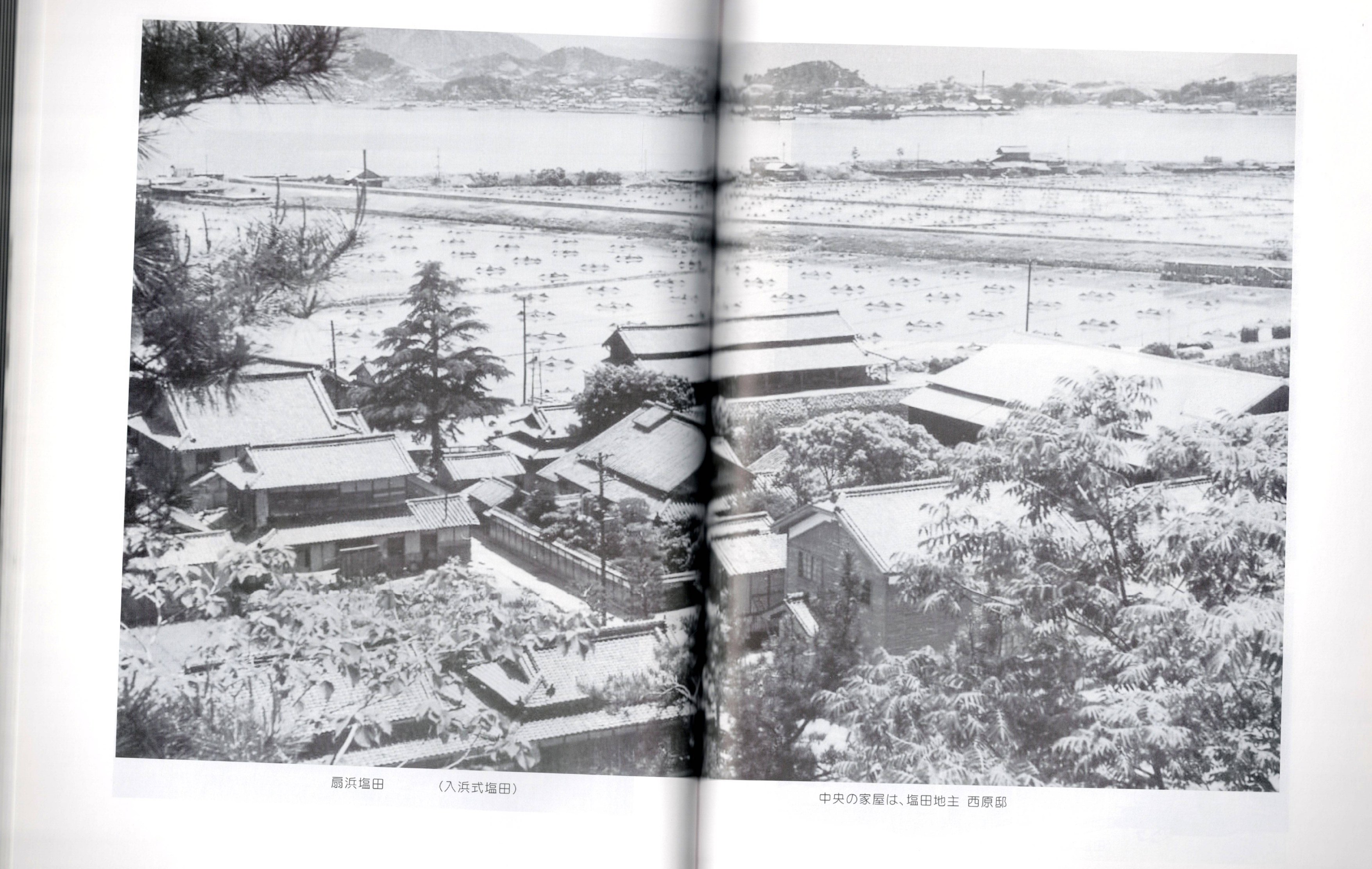
The Mukōda Ōgihama salt field (向田扇浜塩田) is the most fully documented of the island's salt fields.
向田扇浜塩田は、島の塩田のうち最も詳しく記録されているものである。
In 1834 (Tenpō 5), the Mukōda headman Nishihara Shōzō (西原庄蔵 (TENTATIVE)), wishing for the village's prosperity, threw in his private fortune and built the Ōgihama salt field by reclaiming land between Mukōda and the then-sea-separated island of Wariishijima (割石島 (TENTATIVE)) (さぎしま讃歌 p.119).
1834年(天保5)、向田の庄屋西原庄蔵(読みTENTATIVE)は村の繁栄を願い、私財を投じて、当時海で隔てられていた割石島(読みTENTATIVE)との間を干拓して扇浜塩田を築いた(『さぎしま讃歌』p.119)。
Because the work was in a place with strong tidal currents, the dike that had been built was repeatedly broken down by strong waves and wind, making the construction extremely difficult (さぎしま讃歌 p.119). Construction began in 1832 (Tenpō 3) and the Ōgihama salt field, with an area of about 20 chōbu (町歩), was finally completed in 1834 (Tenpō 5) (さぎしま讃歌 p.119).
潮流の激しい場所での工事であったため、築いた堤防は強い波と風で何度も壊され、工事は極めて困難であった(『さぎしま讃歌』p.119)。工事は1832年(天保3)に始まり、面積約20町歩の扇浜塩田は1834年(天保5)にようやく完成した(『さぎしま讃歌』p.119)。
The completed Ōgihama salt field provided employment for more than 100 people and brought great prosperity to the people of Mukōda (さぎしま讃歌 p.119).
完成した扇浜塩田は100人以上の雇用を生み、向田の人々に大きな繁栄をもたらした(『さぎしま讃歌』p.119)。
Sources / 出典
- さぎしま讃歌, p.2-7 (もくじ / table of contents): district salt fields and the two production types.
- さぎしま讃歌, p.118: the three methods (age-hama, irihama, ryūka-shiki / ion-exchange), and the district-by-district list of irihama salt fields with creation years (Mukōda, Sagi, Kosagishima).
- さぎしま讃歌, p.119: the building of the Mukōda Ōgihama salt field by Nishihara Shōzō (start 1832, completion 1834, ~20 chōbu, 100+ employed).
- さぎしま讃歌, p.120: irihama ground-percolation process, brine (kansui), the 200 tons sand/seawater per 1 ton salt figure, and the hamako / hamabiki walking-distance figure.
- さぎしま讃歌, p.124: ryūka-shiki bamboo-branch method, labor 5-to-1 reduction (brine-yield figures OCR-damaged, not reproduced).