draft
Demographics / 人口統計
Overview / 概要
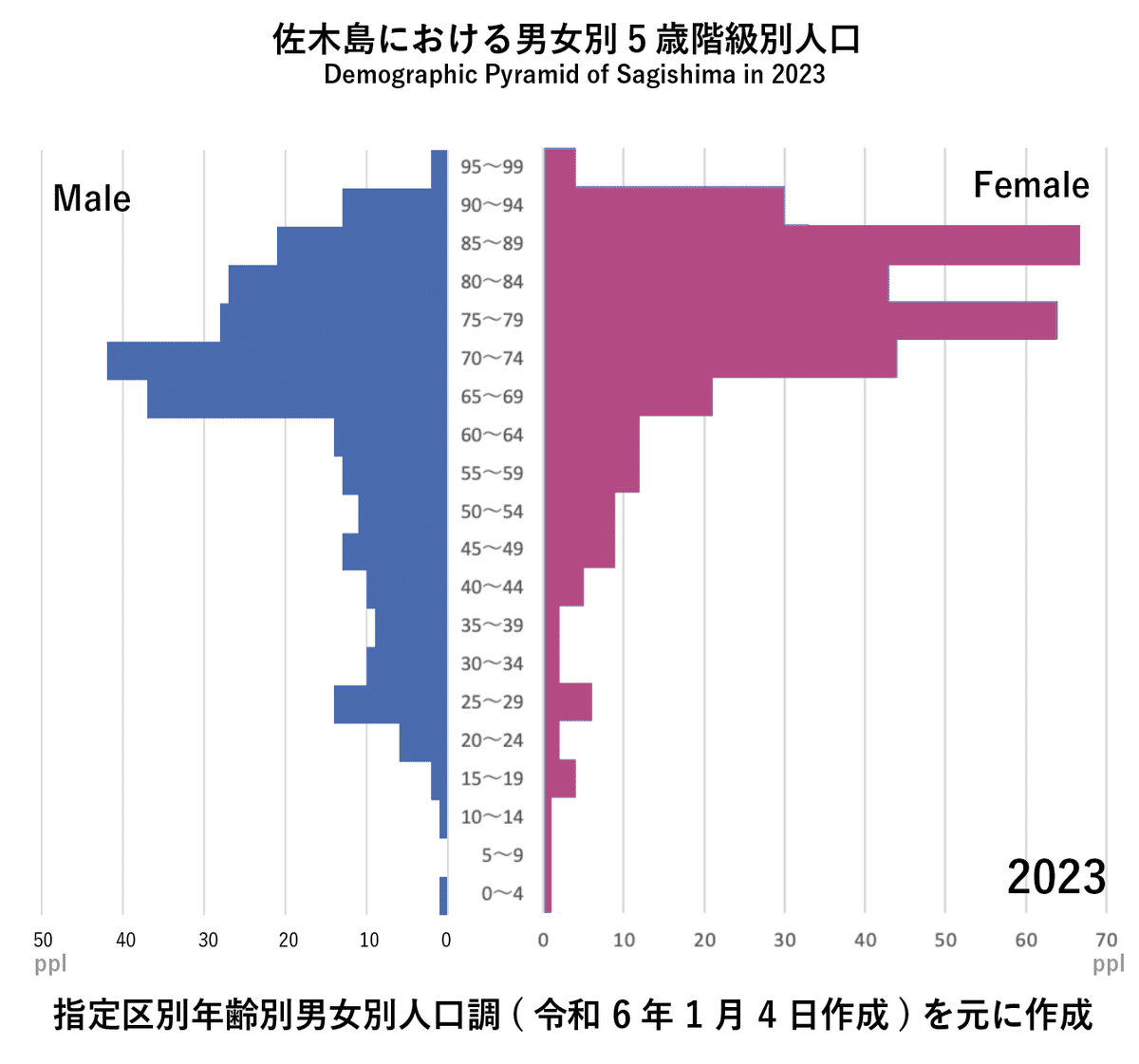
The note.com post "佐木島の人口ピラミッド / The demographic pyramid of Sagishima" (Nao Kono, January 2024) records the numbers with a specificity worth preserving.
note.comの投稿「佐木島の人口ピラミッド / The demographic pyramid of Sagishima」(河野なお、2024年1月)は、残しておく価値のある具体性をもって数値を記録している。
| Measure / 指標 | Sagishima (2023) / 佐木島(2023年) | Japan (2023) / 日本(2023年) |
|---|---|---|
| Population 人口 |
579 | 124 million 1億2400万 |
| Aging rate (65+) 高齢化率(65歳以上) |
70.6% | 29.1% |
| Average age 平均年齢 |
~68 | 48.4 |
The 1955 population was ~3,600; the island has contracted by roughly 84% in seventy years (see Postwar Contraction).
1955年の人口は約3,600人だった。島は70年でおよそ84%縮小したことになる(戦後の縮小を参照)。
A second 2023 figure corroborates the picture: Japanese Wikipedia, citing official data as of 2023-03-31, records 596 residents in 380 households with an aging rate of 71.08%. The 579 (note.com) and 596 (official) counts differ only by count-date and method; the older "~650" figure seen elsewhere is likely rounded or earlier. The takeaway is stable: roughly 580 to 600 people, more than seven in ten of them over 65.
もう一つの2023年の数値もこの構図を裏づけている。日本語版ウィキペディアは、2023年3月31日時点の公式データを引用し、380世帯596人、高齢化率71.08%と記録している。579人(note.com)と596人(公式)という数の差は、集計の日付と方法の違いにすぎない。他で見られるより古い「約650人」という数値は、おそらく丸めたものか、それ以前のものである。結論は揺るがない。およそ580人から600人、その10人に7人以上が65歳を超えている。
What this means / その意味
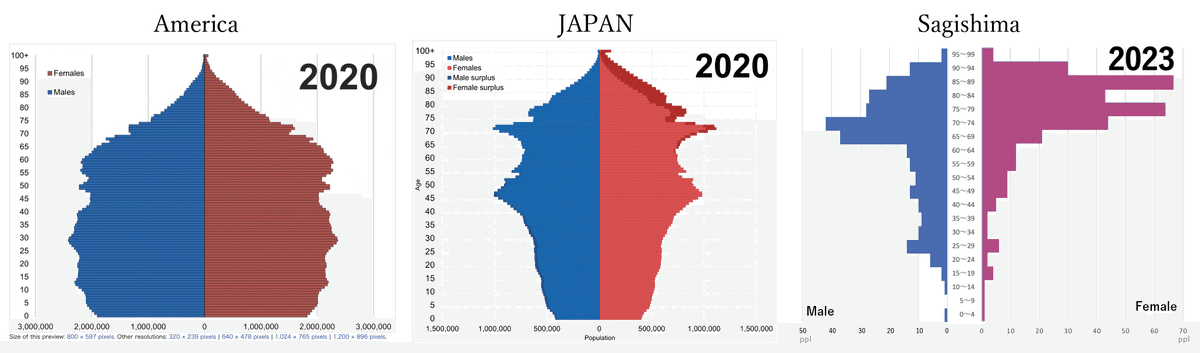
Seven of every ten people on Sagishima are over sixty-five; the average islander is sixty-eight. Nao's post puts it plainly: "The influx of young people is essential to maintaining the community." This is the framing inside which the Foundation works. The texture follows from the numbers: an infrequent bus, a small single store, vacant houses whose occupants have died or left. To be a young arrival is unusual to the point of being noticed and, before long, recognized. A serious situation, not a tragic one; treating it as the former is one of the small daily disciplines of being here.
佐木島では10人に7人が65歳を超えており、島民の平均年齢は68歳である。河野なおの投稿はそれを端的にこう述べている。「若者の流入は、コミュニティを維持するために不可欠である」。これが、財団が活動する枠組みである。その手触りは数値から自ずと生まれる。本数の少ないバス、小さな一軒だけの店、住人が亡くなったり去ったりして空いた家々。若い移住者であることは、目に留まり、やがて顔を覚えられるほどに珍しい。これは悲劇ではなく、深刻な状況である。後者として扱うことが、ここにいることの小さな日々の規律の一つである。
Open questions / 未解決の問い
- Population figure varies by source but converges on ~580 to 600 for 2023 (579 note.com; 596 official via Wikipedia); the older ~650 is likely rounded or earlier. See open questions. 人口の数値は資料によって異なるが、2023年については約580人から600人に収束する(note.comは579人、ウィキペディア経由の公式は596人)。より古い約650人は、おそらく丸めたものか、それ以前のものである。未解決の問いを参照。
- The Foundation does not yet know most islanders by name (see Families). 財団はまだ、ほとんどの島民を名前で知らない(島の家族を参照)。
Historical population, before the 2023 snapshot / 2023年の現状より前の人口史
The existing page captures the island as it is now (roughly 580 to 600 people, more than seven in ten over 65). Two local histories, Sagishima Sanka (さぎしま讃歌) and Sōroshū (双鷺洲), preserve the long arc that produced that snapshot, including a household-by-decade record for the smaller sister island, Kosagishima. The figures below should be read as a historical complement to the modern data already on this page, not as a replacement.
このページの既存部分は、現在の島の姿(およそ580人から600人、その10人に7人以上が65歳超)をとらえている。二冊の郷土誌『さぎしま讃歌』と『双鷺洲』は、その現状に至るまでの長い軌跡を残しており、姉妹島である小佐木島については世帯数の十年ごとの記録も含まれている。以下の数値は、すでにこのページにある現代のデータを置き換えるものではなく、歴史的に補完するものとして読まれたい。
Note: The bulk of these figures are extracted from Sōroshū (双鷺洲), which itself quotes deeper primary sources (the Mihara City History 三原市史, prefectural shrine registers, school anniversary volumes, and Edo-period village survey documents). Citations below trace to those quoted primaries where given. Several entries carry era-year / Western-year mismatches or apparent OCR errors in the source and are flagged inline. Native-speaker and local-historian review is recommended before any formal use.
注:これらの数値の大半は『双鷺洲』から抽出したものであり、同書自体がより深い一次資料(三原市史、県の神社名鑑、学校の周年記念誌、江戸期の村方調査文書)を引用している。以下の出典は、示されている限りその引用元の一次資料まで遡る。いくつかの項目には、原典における和暦と西暦の不一致、あるいはOCR由来と思われる誤りがあり、その都度注記した。正式な利用の前に、ネイティブおよび地域史家による確認を推奨する。
Why the island emptied / 島が空になっていった理由
Kosagishima prospered through shipbuilding from the Meiji era into the Taishō era. As of the early 2010s it suffered from inconvenient transport and the absence of any notable industry; young people left for work elsewhere, leaving an island of only elderly residents (さぎしま讃歌 p.173).
小佐木島は明治から大正にかけて造船で栄えた。2010年代初頭の時点では、交通の不便さと目立った産業のなさに苦しんでいた。若者は仕事を求めて島を出て、高齢者だけの島が残された(さぎしま讃歌 p.173)。
The departure of young people, together with the inconvenience of island life, produced a falling birthrate and an aging population. Mountain fields were gradually abandoned and vacant houses (akiya 空き家) began to appear; the island's population declined rapidly year by year, and the number of kindergarten and elementary school children fell sharply (さぎしま讃歌 p.174).
若者の流出と島の暮らしの不便さが相まって、出生率の低下と高齢化が進んだ。山の畑は次第に放棄され、空き家が現れはじめた。島の人口は年を追って急速に減り、幼稚園児と小学生の数も激減した(さぎしま讃歌 p.174)。
Kosagishima households and population over time / 小佐木島の世帯数・人口の推移
The smaller island's record runs almost unbroken from the Edo period through 2015 (the latest year the source records). The trajectory (from twenty-some households down to single digits) is the clearest available illustration of the depopulation described above.
姉妹島の記録は、江戸期から2015年(原典が記録する最新の年)までほぼ途切れずに続いている。その推移(二十数戸から一桁へ)は、上述の過疎をもっとも明瞭に示している。
| Year / 年 | Households / 世帯 | Population / 人口 | Notes / 注 |
|---|---|---|---|
| 1581 (Tenshō 9) / 天正9年 | (founding parish) | At founding, the shrine had 15 parishioner households (氏子15戸); an alternate figure of 122 households is also noted, and the island was then the territory of the Mukai family (向井家) (双鷺洲 p.155). 当時の氏子数15戸(122戸とも)。 | |
| 1818 (Bunsei 1) / 文政元年 | 7 (人家七軒) | 20 (人数20) | Whole island a government forest (御建山); yield just over 4 koku 9 to (高四石九斗余). Per Susuwa-mura survey doc in the Mihara City History (双鷺洲 p.117 → 須波村「国郡志御用に付下しらべ書出帳」/ 三原市史). 須波村 reading TENTATIVE. |
| 1822 (Bunsei 5) / 文政5年 | 7 | (双鷺洲 p.118) | |
| 1872 (Meiji 5) / 明治5年 | 1 | 16 | (双鷺洲 p.118) |
| 1880 (Meiji 13) / 明治13年 | 15 | 16 | Population 16 looks inconsistent with 15 households; likely an OCR/transcription error in the source (双鷺洲 p.118). 人口16は世帯15と矛盾。原典のOCR/転記誤りの可能性。 |
| 1883 (Meiji 16) / 明治16年 | 15 | 77 | Source prints "明治16年(1881)"; Meiji 16 = 1883, so the source's Western year is wrong (双鷺洲 p.118). 原典の括弧内西暦は誤り。 |
| 1955 (Shōwa 30) / 昭和30年 | 11 | 90 | 8 high-school students commuted to the Sagiura branch of Hongō High School (本郷高校鷺浦分校) (双鷺洲 p.120). |
| 1959 (Shōwa 34) / 昭和34年 | 25 | 40 elementary/middle/high-school students (双鷺洲 p.120). | |
| 1973 (Shōwa 48) / 昭和48年 | 22 | 62 | 2 elementary, 6 middle, 7 high-school students (15 total). Surrounding p.121 figures are OCR-scrambled and unreliable (双鷺洲 p.120-121). |
| 1984 (Shōwa 59) / 昭和59年 | 21 | 43 | Of these, 6 were under 60 years old and 4 commuted to work in Mihara City (三原市). An adjacent "昭和58年(1984)" entry repeats 21/43, but Shōwa 58 = 1983, an era/Western mismatch (双鷺洲 p.121, p.123). |
| 1985 (Shōwa 60) / 昭和60年 | 22 | 61 | Appears out of chronological order in the OCR (双鷺洲 p.121). |
| 1991 (Heisei 3) / 平成3年 | 20 | 41 | No residents under 60 years old remained (双鷺洲 p.121). 60歳未満の住民はいなくなった。 |
| 1998 (Heisei 10) / 平成10年 | 19 | 37 | (双鷺洲 p.121) |
| 2005 (Heisei 17) / 平成17年 | 8 | 18 | Source prints "平成7年(2005)"; Heisei 7 = 1995, so the era year contradicts the Western year. Context indicates 2005 (双鷺洲 p.121). 原典の和暦は西暦と矛盾。 |
| 2011 (Heisei 23) / 平成23年 | 8 | 11 | (双鷺洲 p.121) |
| 2013 (Heisei 25) / 平成25年 | 6 | 10 | (双鷺洲 p.121) |
| 2015 (Heisei 27) / 平成27年 | 6 | 8 | (双鷺洲 p.121) |
Edo-period snapshots of both islands / 両島の江戸期スナップショット
A village survey document quoted in the Mihara City History records the two islands side by side. The main island, Ōsagishima (大佐木島), had 67 households (家六拾七軒), a population of roughly 200 (人数式百人斗), one temple, one tutelary shrine, and a village yield of over 74 koku (高七拾四石余) (双鷺洲 p.80 → 須波村「国郡志用に付下しらべ書出帳」/ 三原市史).
三原市史に引用された村方調査文書は、両島を並べて記録している。本島である大佐木島は、家67軒、人数およそ200人、寺1ケ寺、氏宮1社、村高74石余であった(双鷺洲 p.80 → 須波村「国郡志用に付下しらべ書出帳」/ 三原市史)。
In the same document Kosagishima (小佐木島) is recorded with a circumference of 33 chō 2 ken (周迴三十三町二間), entirely designated as government-managed forest (御建山), about 7 houses, a population of about 20 (人数式拾人斗), and a yield of just over 4 koku 9 to (高四石九斗余). The household line is garbled in the OCR ("一人冢七軒"); count is uncertain (双鷺洲 p.80). The same survey doc also separately referenced as さぎしま讃歌's TOC includes a dedicated section on 鷺浦町の人口 (Population of Sagiura Town) (さぎしま讃歌 p.2-7, もくじ).
同じ文書で小佐木島は、周迴33町2間、全島が御建山、家およそ7軒、人数およそ20人、村高4石9斗余と記録されている。世帯数の行はOCRで乱れており(「一人冢七軒」)、戸数は不確実である(双鷺洲 p.80)。『さぎしま讃歌』の目次には、旧鷺浦町の人口を扱う独立した節「鷺浦町の人口」がある(さぎしま讃歌 p.2-7、もくじ)。
Parishioner households (ujiko / danka) by shrine and temple / 神社・寺院別の氏子・檀家戸数
Religious registers are the most consistent surviving headcount for the pre-modern and modern village. They count households (戸 / 軒), not persons, and different registers disagree, so they are best read as orders of magnitude.
宗教関係の名簿は、近世から近代の村でもっとも一貫して残る戸数の記録である。これらは人数ではなく戸数(戸・軒)を数えており、名簿ごとに数値が食い違うため、おおよその規模として読むのがよい。
- The Bunka 11 (1814) record lists 183 parishioner households (檀家183軒) across Hosojima (細島), what appears to be Mukōjima (向島, reading TENTATIVE), and Sagishima (佐木島) belonging to the temple (双鷺洲 p.96-97, 資料3). 文化11年の記録は、細島・向島(TENTATIVE)・佐木島にまたがる檀家183軒を挙げている。
- The Hachiman Shrine (八幡神社): 174 parishioner households per the Meiji 45 (1912) local-history materials (氏子174戸; precinct 601 tsubo, 4 branch shrines, with main hall, heiden, haiden, kagura-den, and corridor detailed) (双鷺洲 p.139, 明治45年郷土資料); and 185 parishioner households per the Hiroshima Prefecture Shrine Register (氏子185戸, 広島県神社名鑑) (双鷺洲 p.139). 八幡神社:明治45年資料で氏子174戸、広島県神社名鑑で氏子185戸。
- A shrine founded in Tenshō 9 (1581) had 15 parishioner households at founding (alternate figure 122) and 30 households (氏子30戸) per the Hiroshima Prefecture Shrine Register (双鷺洲 p.155). 天正9年創建の社:創建時の氏子15戸(122戸とも)、神社名鑑では氏子30戸。
- A Meiji 45 (1912) shrine record gives 139 parishioner households (氏子139戸) (双鷺洲 p.157). 明治45年の社記録:氏子139戸。
- Associated with the Hiro Shrine record: a figure of 276 people (276人) and, separately, 205 households (205戸) (双鷺洲 p.163). LOW confidence; bare figures without clear context. 比治山(?)社の記録に関連して276人、別に205戸。文脈不明、低信頼度。
- Associated with the Kōjin Shrine (Kosagi) entry: 22 households (22戸) (双鷺洲 p.165). LOW confidence; bare figure. 荒神社(小佐木)の項に22戸。低信頼度。
Farm households and rural economy / 農家戸数と農村経済
In 1990 (Heisei 2) farm households on Sagishima numbered 314 in total: 89 full-time, 225 part-time, and 308 fruit-tree-growing households. With the spread of greenhouse cultivation the agricultural slack season disappeared, and year-round planned vegetable growing developed centered on Sunoue (須ノ上). Wakegi (Welsh onion) cultivation involved 44 households selling 341 tons (双鷺洲 p.248; the same 314 / 89 / 225 / 308 figures also at さぎしま讃歌 p.25).
1990年(平成2年)、佐木島の農家戸数は計314戸であった。専業89戸、兼業225戸、果樹栽培308戸。ハウス栽培の普及により農閑期がなくなり、須ノ上を中心に周年の計画的な野菜栽培が発展した。わけぎ栽培は44戸が手がけ、341トンを出荷した(双鷺洲 p.248;同じ314/89/225/308の数値は さぎしま讃歌 p.25 にも)。
A large household in Sagi (佐木) owned about 4 chō of farmland and kept about three servants, renting out roughly half its land to tenants. Full-time farming required 1 chō 2 to 3 tan or more, but many households farmed only about 7 to 8 tan. At the end of the Meiji era, servant wages were at most 6 yen per year for women and 15 yen per year for men (双鷺洲 p.252 → 三原市史).
佐木の大きな家は約4町の農地を持ち、奉公人を三人ほど抱え、土地のおよそ半分を小作に貸していた。専業には1町2〜3反以上を要したが、多くの家は7〜8反ほどの規模にすぎなかった。明治末の奉公人の給金は、女で年6円、男で年15円が上限であった(双鷺洲 p.252 → 三原市史)。
Schools and youth organizations / 学校と青年団
- Sagiura Middle School was founded in 1947 (Shōwa 22). A founding enrollment is transcribed as 28 (生徒数28名), but the year-cohort figures (92 first-years, 75 second-years, 51 third-years; total 218) contradict that, so the 28 is likely an OCR/transcription error (双鷺洲 p.210 → 鷺浦中学校創立五十周年記念誌). 鷺浦中学校(昭和22年創立)。生徒数28名とあるが学年合計218名と矛盾、誤記の可能性。
- By the time of the 50th-anniversary volume (1997, Heisei 9), the alumni association had over 2,000 members (二千余名) (双鷺洲 p.217 → 鷺浦中学校創立五十周年記念誌). 創立50周年時、同窓会員は2,000名余。
- As of 2014 (Heisei 26), Sagiura Elementary School had 1 pupil (児童数1名) and Sagiura Kindergarten had 5 children (園児数5名) (双鷺洲 p.223). 2014年、鷺浦小学校の児童1名、鷺浦幼稚園の園児5名。
- 1952 (Shōwa 27) youth-class students were mostly farmers; others were public officials (3), teachers (2), factory workers (4), and salt-industry workers (塩業, 9) (双鷺洲 p.229). 昭和27年の青年学級生は大半が農業、ほか公務員3・教員2・工員4・塩業9。
- 1950 (Shōwa 25): the Sagiura Village Youth Association (鷺浦村青年団) was formed; membership ran up to age 25 for men and 20 for women, with culture, athletics, and industry sections (双鷺洲 p.238, lecture by Shirasu Shunzō 白須俊三, reading TENTATIVE). 昭和25年、鷺浦村青年団結成。
- 1953 (Shōwa 28): the youth corps had about 170 members, roughly 130 male and 40 female (双鷺洲 p.230). A parallel passage gives about 80 men and about 40 women ("B0名" is an OCR artifact, likely 80) (双鷺洲 p.235). 昭和28年、青年団約170名(男約130・女約40)。p.235では男約80・女約40。
- The maximum member age was 20, later (around Taishō 9 / 1920) extended to 25 (双鷺洲 p.235). 入団上限は20歳、のち大正9年頃に25歳へ。
- The Mukōda Youth Association (向田青年団) had over 100 male and female members; from about Shōwa 48 to 60 (c.1973-1985) its membership declined as the local youth population shrank, and from about age 25 members also served as fire-brigade members (双鷺洲 p.238-239). 向田青年団は男女100名超。昭和48〜60年頃、若年人口の減少とともに会員数も減少。
Sources / 出典
- Primary: "佐木島の人口ピラミッド / The demographic pyramid of Sagishima" (Nao Kono, note.com
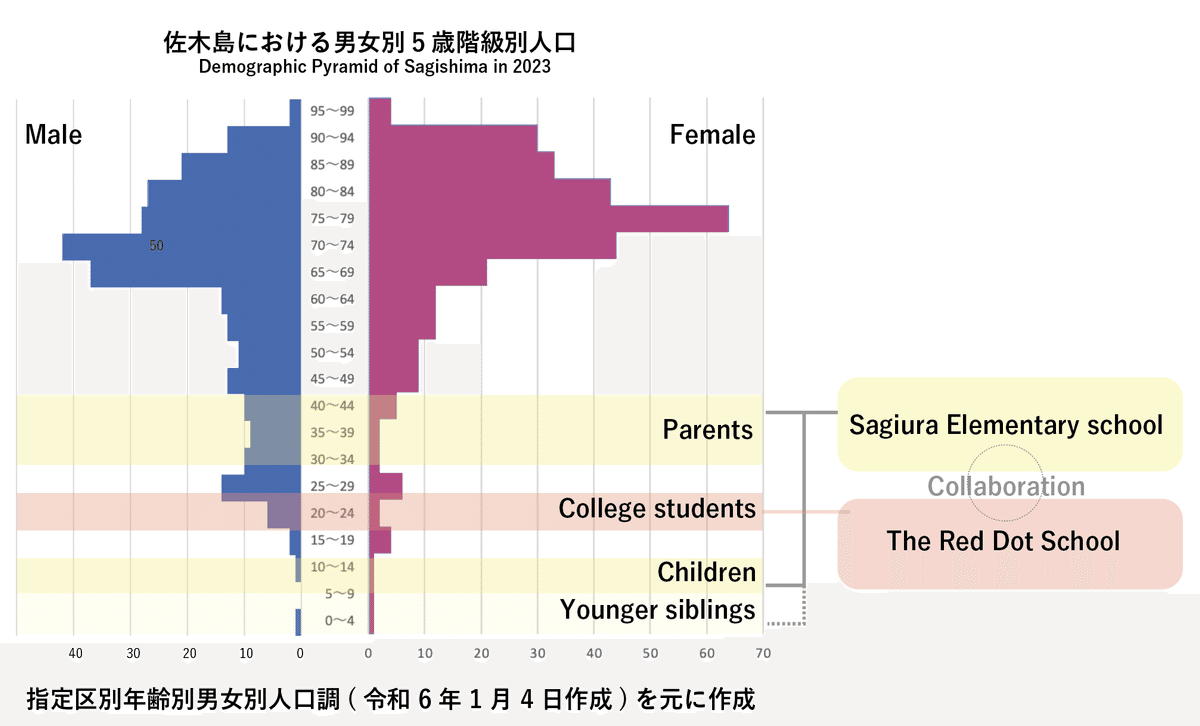
n241cbe045f22, 2024-01-21), archived locally. All three of Nao's pyramid charts (plain Sagishima, the US/Japan/Sagishima comparison, and the RDS-annotated version) are drawn from that post and kept in_assets/data_charts/; the annotated chart was built from the designated-district age/sex population survey dated 令和6年1月4日 (2024-01-04). Theory of Change. See bibliography. 一次資料:「佐木島の人口ピラミッド / The demographic pyramid of Sagishima」(河野なお、note.comn241cbe045f22、2024-01-21)、ローカルに保存済み。河野なおの3点のピラミッド図(佐木島単独、アメリカ/日本/佐木島の比較、そしてRDSの注釈付き版)はいずれもこの投稿に由来し、_assets/data_charts/に保管されている。注釈付きの図は、令和6年1月4日(2024-01-04)付の指定地区別・年齢別・男女別人口調査をもとに作成された。Theory of Change。参考文献を参照。